

Climate Transition - Part 3: The winners and losers
A faster climate transition produces relative winners and losers compared to the baseline scenario. In a slower scenario, there are only losers.

Things to remember:
- A rapid climate transition creates relative winners (countries with strong renewable energy capacity) and losers (fossil fuel exporters).
- In a slow transition, everyone loses.
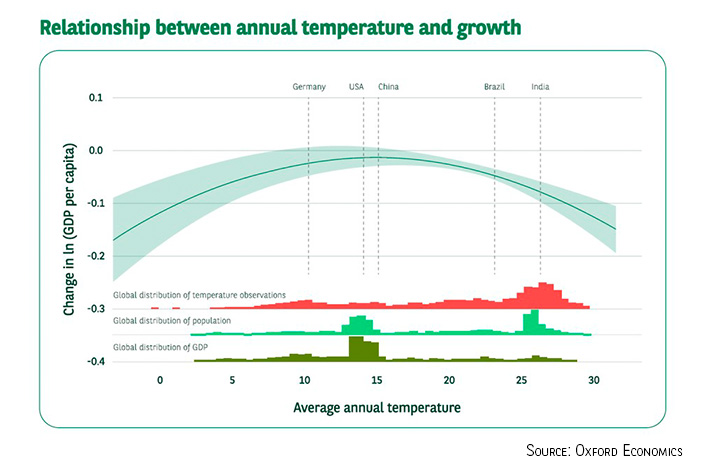
- Labour productivity is highest at an average annual temperature of 15°C and decreases in both colder and warmer climates.
The ‘we’ll just muddle through’ scenario
In the baseline scenario from the Oxford Economics think tank, global temperatures will rise by 2.2° Celsius by 2060 compared to the pre-industrial era. In this ‘we’ll just muddle through’ scenario, growth in the euro zone slowly declines from 1% to 0.7%. The global carbon price has already peaked at $40 per tonne of CO2, which is nowhere near enough to stabilise the temperature. By 2100, the temperature will have risen further to 3°C, further undermining trend growth.
Winners…
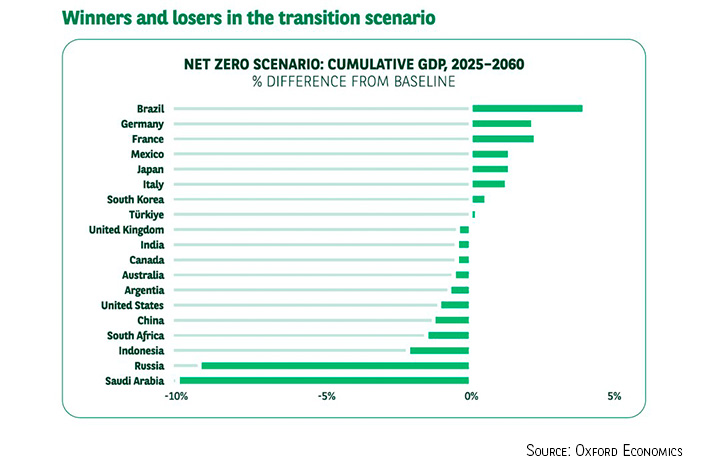
In a rapid, orderly transition to net zero by 2050, Brazil stands to gain the most compared with the baseline scenario, closely followed by Germany and France. Saudi Arabia and Russia end well below the zero line. The pattern behind this ranking is remarkably consistent: winners have significant renewable electricity capacity, which limits their exposure to the carbon tax and, consequently, the pressure on consumption.
Brazil is the world’s second-largest hydro power producer, and today gets 84% of its electricity from renewable sources. For Europe, that share stands at 47.3%, but this still comfortably exceeds the global average of 34%. Other relative winners have access to the metals and minerals required by green technology, with copper at the forefront.
… and losers
Losers include those countries that derive significant revenue from fossil fuels: if the world consumes less oil and gas, their export earnings will evaporate. Saudi Arabia and Russia are feeling the pinch most acutely, but the US is also faring less well. In a real transition scenario, most of the countries at the bottom of the ranking will also feel the negative impact on purchasing power of the carbon price yet to be introduced.
Productivity is not heat resistant
So far, nothing very surprising. But things become more interesting when you look at which countries are physically hit harder as temperatures rise, because there is a curve underlying this that few are aware of. The relationship between the annual average temperature and economic growth is not a straight line, but rather mountain-shaped growth – or more precisely, labour productivity – peaks at an average annual temperature of around 15°C and declines in both colder and warmer climates.
Countries such as Germany, which are below that optimum, would in theory even see slight gains with further warming. But countries such as India, Indonesia and Brazil, on the other hand, are already well past that peak. Each extra degree pushes them deeper into the descending part of the curve. It is these densely populated, hot countries, amongst others, that will suffer severe productivity losses in the catastrophe scenario.
Vulnerable Northern Hemisphere
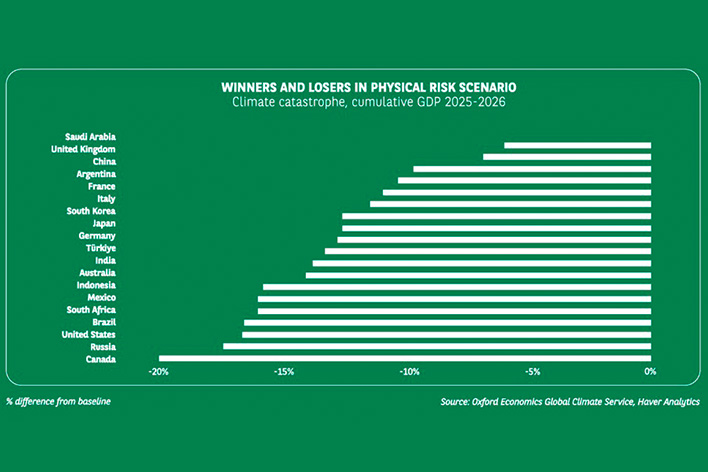
But they're not the only ones who are vulnerable. In practice – in the scenario where climate policy fails – those same theoretically advantaged cold countries turn out to be the ones taking the biggest absolute hits. Canada will lose up to 20% of its GDP cumulatively by 2060, closely followed by Russia and the United States.
The explanation is a classic case of ‘the map is not the territory’: warming does not proceed at the same rate everywhere, and the Northern Hemisphere is warming faster than the global average. A country that, on paper, is well below its temperature optimum can therefore quickly be pushed beyond that optimum. Furthermore, temperature deviations are expected to be greater in the Northern Hemisphere. This leads to greater volatility and more extreme weather conditions, resulting in direct capital destruction.
Dependence on fossil fuels? Everyone loses!
In that catastrophic scenario, Saudi Arabia initially even appears to be the least bad performer in the class, simply because sustained demand for fossil fuels keeps oil revenues afloat. But it's no coincidence that the graph ends with the sobering observation that rising temperatures are gradually eroding that lead. There is no scenario in which dependence on fossil fuels pays off in the long run. Ultimately, everyone loses in this scenario.
Waiting for Godot
The lesson to be learnt? In the event of a complete transition leading to ultimately stable temperatures, there are clear winners and losers compared to the current - also far from ideal - baseline scenario, with Brazil and Saudi Arabia as polar opposites. If the world allows the transition to fail completely? Then that distinction gradually disappears and everyone loses; the fossil fuel exporter just a little later than the rest, but just as surely.
It’s a bit like waiting for Godot: you can keep putting it off for a while and keep making promises of ‘tomorrow’, but eventually the bill will come due – for everyone at the table.