

Climate Transition - Part 2: The price of carbon, or the lack thereof
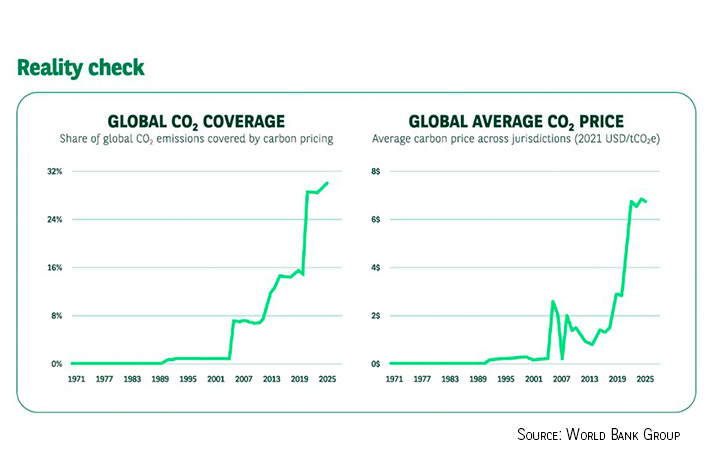
There is near-consensus among economists as to what a tonne of CO2 would need to cost in order to bring about a genuine change in our behaviour: somewhere between 50 and 100 dollars. The world pays on average 6 to 8 dollars for this. That’s not just a small gap – it’s a different universe.
What to remember:
- Right now, the price of CO2 is too low to really change behaviour. Achieving net zero by 2050 will require a price of $470 per tonne of CO₂.
- Only 32% of global emissions are subject to a carbon price.
- Europe is making rapid progress, but the rest of the world needs to follow suit if we’re to keep global warming below 2°C. The clock is ticking.
Two-thirds of the planet still emits CO2 cost free
Even today, the coverage rate of that pricing scheme – where such a carbon price applies – struggles to reach even 32% of global emissions. In other words, two-thirds of the planet still emits CO2 cost free.. That immediately explains why it seems we’re making no progress on climate policy. Generally speaking, that’s just the way it is.
Which temperature scenarios?
According to Oxford Economics, in order to achieve a credible net-zero pathway by 2050, we need to reach $470 per tonne – on top of which we’ll need massive investment. In the other two scenarios, where the temperature is stabilised around 1.6° Celsius, peak prices of $942 and $979 dollars per tonne apply!
The alternative? We raise the global carbon price to $40 dollars per tonne. But as we saw in Part 1, this leads to a warming of at least 2.2°C by 2060 and 3°C by 2100. In the catastrophic scenario, we’re talking about temperatures that rise by 2.7°C and 4.4°C, resulting in a gigantic physical risk.
Alarmingly unequal
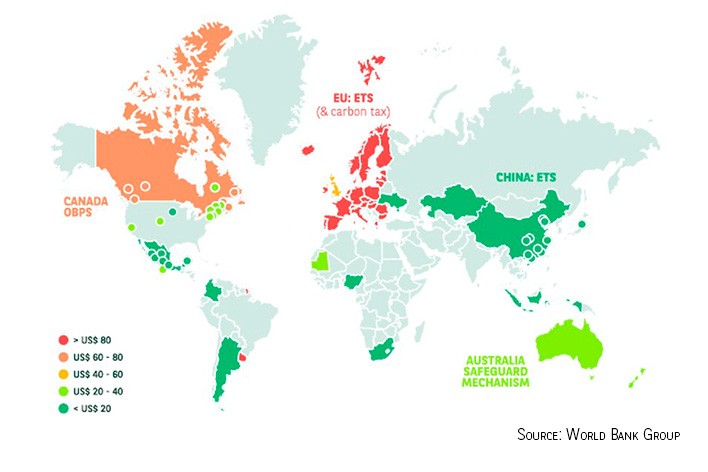
Anyone looking at the heatmap of jurisdictions that have already implemented a carbon price will see just how alarmingly unequal the distribution is. Europe is turning dark red, with an average carbon price of over $80 per tonne as a result of the EU Emissions Trading Scheme (ETS) and national carbon taxes. Canada follows with its Output-Based Pricing System, with a price of between $60 and $80 per tonne. There’s also China, with its own emissions trading system and the Australia Safeguard Mechanism. But if you look further across the map, you’ll see mostly blank patches. The United States has virtually no price regulation at the federal level, and the bulk of South America and Africa remain blank.
Europe leads the way
We see the same inequality in the revenue figures: of the $107.5 billion in global carbon revenues in 2025 (80.3 billion from emissions trading, 27.2 billion from carbon taxes), roughly three-quarters comes from European sources, with the EU ETS standing out as the clear leader. Incidentally, the two underlying mechanisms are fundamentally different. Under an ETS, the government sets a cap on total emissions, after which companies trade allowances amongst themselves, so that the price is determined by supply and demand. In the case of a carbon tax, the government simply imposes a rate directly, without any market mechanism. Worldwide, there are 37 ETSs and 43 carbon taxes operating in parallel. This patchwork of mechanisms explains why the prices on the map vary so much.
The conclusion is obvious: this is not a call for Europe to move even faster. Europe is already moving fast enough – perhaps even too fast – compared with the rest. It’s a call to the rest of the world to finally join in, rather than just stand on the sidelines. And we need to act quickly if we’re to have even the slightest chance of keeping global warming below 2°C.