

How tech imports from China threaten our jobs
The first Chinese shock, when China flooded the world with cheap goods, peaked in 2007. The second, ‘China Shock 2.0’, is now in full swing, as China pours its tech products into global markets (especially Europe). The 2 stories are similar. With 1 critical difference: Chinese imports now exceed our own production capacity.

China is exporting more and more goods that we produce ourselves
The export similarity index measures the extent to which the eurozone’s global exports overlap with China’s. During the first China shock in 2002, about one-quarter of sectors where both economic powers held a comparative advantage overlapped. This meant each largely stayed in its own lane.
Today, the share of products where we compete globally has risen to over 40% on average, with significant variation among EU member states (see below). More alarmingly, the index has surged since 2019. The overlap is concentrated in machinery, transport equipment, and chemicals - precisely the segments driving Europe’s export engine. China is increasingly exporting what we make.
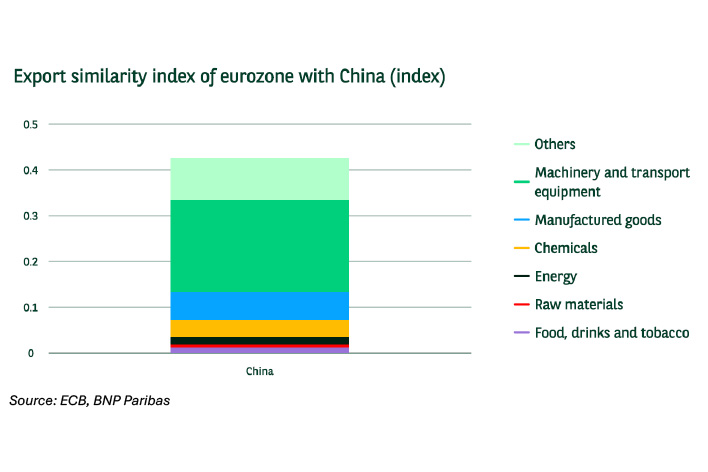
From toys to technology
This is the fundamental difference from the previous wave. The first China shock only touched on Western industry, focusing on specific sectors: toys, textiles, basic electronics - areas where we already faced competition from other emerging markets and would likely have lost ground anyway. The second shock, however, strikes at the heart of European industry: automobiles, mechanical engineering, chemicals, green technologies, advanced manufacturing, and more. In some countries, 50 to 60% of production is now exposed. The fault line has shifted from labour costs to technological capability.
We produce high-tech goods. China is producing more and more of them too. The complexity gap between Chinese and European export products has narrowed significantly. Dutch researchers Ron Stoop of The Hague Centre for Strategic Studies and Geoffroy Feij, affiliated with the employers' organisation FME, demonstrate this using the Product Complexity Index¹.
Stoop and Feij also identified the European regions most threatened by the sharp rise in Chinese exports of complex products between 2020 and 2025. Germany dominates the top 10 with 5 regions: Braunschweig, Stuttgart, Oberpfalz, Tübingen, and Lower Bavaria. The Czech Republic has 3 regions in the ranking, while Hungary has 2. "These are regions built on historically strong manufacturing industries. As a result, they are most exposed to Chinese imports directly targeting their sectors," Stoop and Feij write in the economic journal ESB.
Caught in a vice
The second China shock isn’t driven by a single mechanism. It spreads through 3 simultaneous channels, making it harder to counter. First, imports from China are steadily rising and increasingly targeting advanced sectors. Second, Chinese demand for European capital goods is weakening as China replaces these imports with domestic production. Third, China’s state-linked and subsidised production scale squeezes profit margins across the board.
To visualise this, imagine a three-dimensional vice tightening from all sides: more competition within Europe, shrinking demand in China, and all of it at lower prices. The first 2 channels reflect China’s ‘dual circulation’ strategy. "China is rapidly becoming the OPEC of industrial inputs for the world," as Professor Richard Baldwin noted years ago in The New Global Economy. Meanwhile, China has sharply cut purchases of intermediate goods from abroad to reduce reliance on external supply chains.
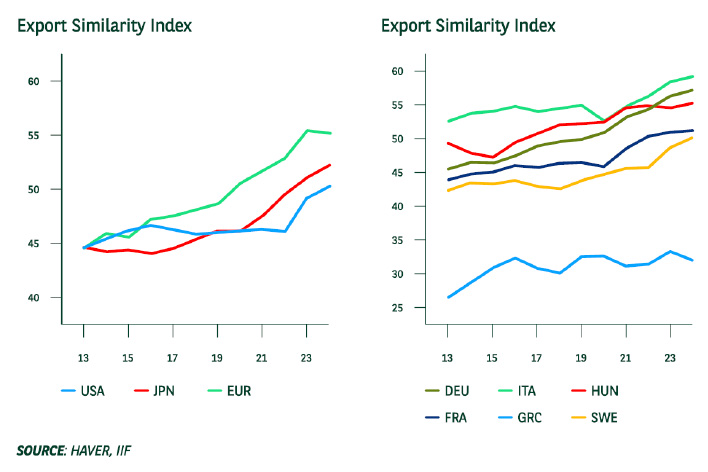
Of all major economic powers, Europe’s export basket most closely aligns with China’s. Even more so than those of the US or Japan. Within Europe, Italy and Germany face the greatest risk (as Stoop and Feij’s study also confirms), and with good reason: they are the continent’s 2 largest industrial engines. Greece remains relatively untouched, simply because its economy leans more on services than advanced manufacturing. Hungary presents the most fascinating - and awkward - case: it scores highly on the similarity index while simultaneously being home to major Chinese battery investments. Both rival and host in one.
Consumer benefits vs employment
During the first shock, the consumer benefits of cheaper imports offset job losses - we calculated this in detail in last week’s article. This time, the bill is steeper, for 3 reasons.
- The second shock hits higher-skilled, better-paid sectors. Cheaper electric cars will hardly compensate for the loss of human capital.
- State subsidies structurally distort competition. The playing field isn’t level. This was likely true before, but in sectors already doomed to disappear.
- Europe’s structural weaknesses - high energy prices and fragmented capital markets - amplify the ongoing shift.
Fair competition comes at a cost
Policymakers aren’t waiting for economists to deliver a final verdict on the second China shock. The Foreign Subsidies Regulation gives the European Commission power to investigate if a Chinese firm setting up in Europe is suspected of still relying on state subsidies from Beijing. A recent application of this rule led to a Chinese rail manufacturer withdrawing from a Spanish public tender once it became clear the bid would face Commission scrutiny. Only one Spanish bid remained, which was twice as expensive. Fair competition comes at a cost.
Other factors come into play: the Carbon Border Adjustment Mechanism (CBAM) and tariffs on electric vehicles. These tariffs, however, should be replaced by less protective minimum price thresholds for European automakers. Yet crafting a coherent EU policy remains a challenge - not so much due to the scale of the bilateral trade deficit, but because of the sectors in which countries specialise. Each country’s position in the supply chain also matters: a German carmaker views Chinese competition differently than a Hungarian government that has just attracted a Chinese battery plant.
Technological convergence
It might be tempting to dismiss this as a simple story where China’s trade surplus is inherently bad. That would be overly reductive. This overcapacity also provides cheap access to electric cars, solar panels, and other technologies whose benefits for European consumers remain poorly mapped - let alone balanced against potential job losses. The real fault line isn’t the headline trade figure but technological convergence: China is now closing the gap on our technological level. This is an entirely different kind of competition from what we faced 15 years ago.
Europe faces intensified competition at home and falling foreign demand, both at once. Key industries will suffer job losses, even if low-cost, high-tech imports soften some of the blow. The strategic choice ultimately boils down to managed competition with clear rules or gradual fragmentation without agreements. The path chosen will be decided in the years ahead.