

Financing a commercial vehicle: should you take out a loan or lease your van?
Are you an entrepreneur or do you run an SME? Do you need a van or another light commercial vehicle to keep your business moving? Discover the specific tax rules that apply to light commercial vehicles, together with an interview with Ilham Chelafa, Local Business Advisor at BNP Paribas Fortis, on the financing solutions available for these vehicles.
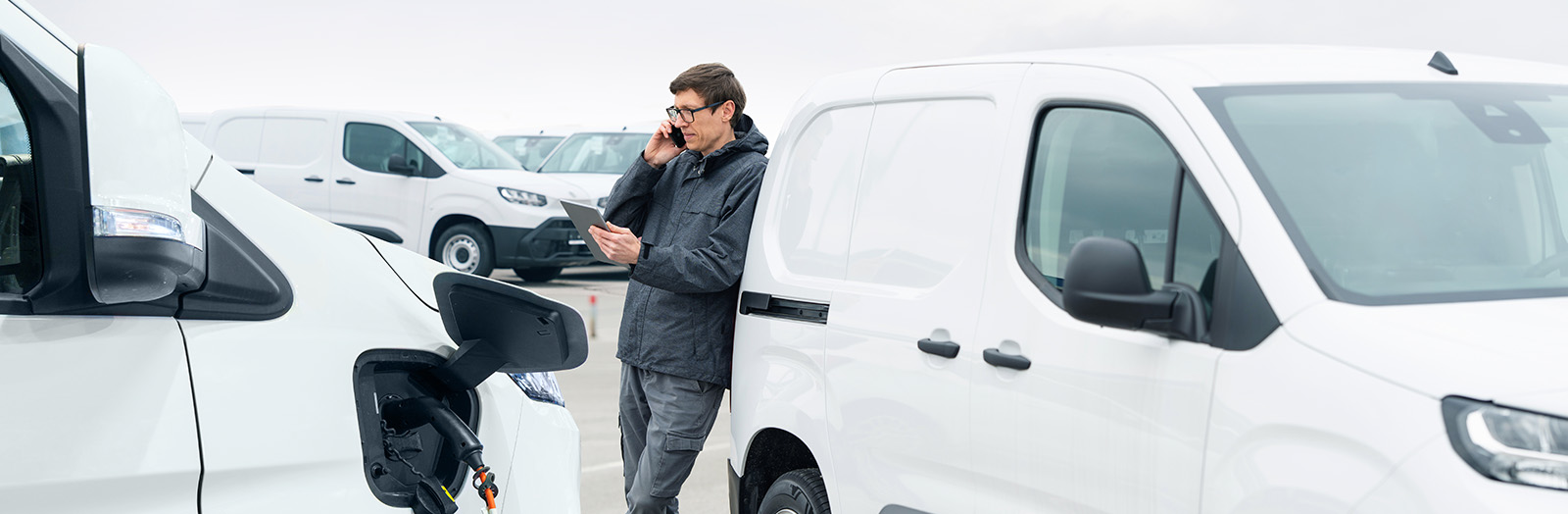
Whether you transport goods or carry tools and equipment to your worksites, does your business depend on a van or another light commercial vehicle? Are you wondering about the financial implications of such an investment?
Before looking at the financing options, let’s first look at the tax rules.
The tax regime for light commercial vehicles
In Belgium, light commercial vehicles designed to transport goods or equipment benefit from a specific tax regime, that differs from the one applying to company cars used to transport passengers.
In simple terms, these vehicles remain tax deductible even if they emit CO₂. This distinguishes them from passenger cars, dual-purpose vehicles and minibuses, whose petrol and diesel versions have no longer been tax deductible since 2026.
Genuine light commercial vehicle: what are the criteria?
To qualify for this tax treatment, the vehicle must meet a number of criteria in addition to being registered as a light commercial vehicle with the DIV.
The main criteria are:
- The vehicle is designed to transport goods.
- Its maximum authorised mass does not exceed 3,500 kg.
- The load area is at least 50% of the wheelbase (the distance between the front and rear axles).
- The load compartment has a continuous floor with no anchor points for seats or benches.
- For pick-ups, the cab must be enclosed and separate from the load area.
Tax rules for genuine light commercial vehicles
In Belgium, genuine light commercial vehicles (LCVs) benefit from a specific tax regime that is generally more favourable than the one that applies to company cars.
- All business expenses relating to the vehicle are up to 100% tax deductible, regardless of its CO₂ emissions. This includes the purchase price, leasing costs, insurance, fuel and other running costs.
- Benefit in Kind (BIK): Any Benefit in Kind is based on the actual private use of the vehicle rather than a fixed amount. For more information, consult the Arval tax brochure.
- VAT: VAT is up to 100% deductible when the light commercial vehicle is used exclusively for business purposes. If the vehicle is also used for private journeys, the maximum flat-rate VAT deduction is 85%.
- Vehicle registration tax: No vehicle registration tax is due on a genuine light commercial vehicle.
Financing a light commercial vehicle: what are your options?
Now that we’ve looked at the tax framework, another question arises: how should you finance a van or another light commercial vehicle? That’s what Ilham Chelafa explains. As Local Business Advisor for Brussels South at BNP Paribas Fortis, she supports entrepreneurs with all their business needs, including financing their business mobility.
Ilham Chelafa: “I mainly work with SMEs in Brussels and the surrounding Brabant area. What kinds of businesses are they, and which sectors do they operate in? The range is very broad: consultants, restaurant owners, construction companies, communications agencies, non-profit organisations and transport companies, for example those specialising in parcel or container transport.”
“As many of our customers buy their vans second-hand, they usually finance them with an instalment loan or, where appropriate, a short-term finance lease.”
Ilham Chelafa
The businesses Ilham advises are therefore very diverse. And thanks to her thorough understanding of their different needs, she is able to guide each customer towards the financing solution that suits them best.
“Most of my customers come to me with a clear idea of what they want and a good understanding of the tax rules. As a result, we generally no longer need to explain that aspect, unlike a few years ago when hybrid commercial vehicles were still tax deductible for corporation tax purposes.”
Commercial vans: second-hand models remain in high demand
Ilham’s advice therefore often focuses on choosing the most suitable financing option.
“The right financing solution depends on several factors, including the number of kilometres the vehicle will cover, how it will be used and the specific characteristics of the vehicle. For example, customers replacing their only van often opt for a second-hand vehicle when replacing their existing one. In those cases, an instalment loan is usually the best option or, depending on the age of the vehicle, a finance lease with a shorter term than for a new vehicle.
Loan, leasing or a combination of both?
What if your business needs more than one vehicle?
“In that case, we can put together a financing solution that’s tailored to your business. Take a roofing company, for example. It might choose operational leasing for the sales manager’s company car, while financing the four vans used on construction sites through finance leasing.
How a vehicle is used is an important factor. Vans that are driven intensively and used to transport goods are naturally more likely to suffer wear and tear. That’s something to consider before choosing operational leasing, as the vehicle must be returned at the end of the contract.”
Compare BNP Paribas Fortis instalment loans, finance leasing and operational leasing solutions for your business vehicle.
Tips, articles and solutions: discover more ways to support your business mobility.
Our answers to your questions about financing your van
What is the difference between leasing and an instalment loan?
The main differences between leasing and an instalment loan lie in ownership of the vehicle, how VAT is paid and the services included.
- With finance leasing or operational leasing, the leasing company remains the legal owner of the vehicle. If you wish, you can become the owner at the end of the lease by paying the purchase option specified in the agreement.
- With an instalment loan, you are the legal owner of the vehicle from the outset. You pay the full VAT amount when you purchase the vehicle. With finance leasing or operational leasing, VAT is included in the lease payments and spread over the duration of the contract.
- With operational leasing, the monthly lease payment generally includes a range of services, such as insurance, vehicle taxes, maintenance, repairs and roadside assistance.
Finance or operational leasing: what’s the difference?
Finance leasing and operational leasing are both long-term financing solutions for your business vehicle. The main differences lie in the services included, the purchase option and the accounting treatment.
- Operational leasing offers an all-inclusive solution. The monthly lease payment typically covers maintenance, repairs, insurance, vehicle registration and road taxes, roadside assistance, tyres and, where applicable, a replacement vehicle. It’s an ideal option if you’re looking for predictable costs and complete peace of mind.
- Finance leasing focuses solely on financing the vehicle. Services such as maintenance, insurance and repairs are not included, giving you the freedom to choose your own providers.
- Both finance leasing and operational leasing may include a purchase option at the end of the contract.
- Finance leasing contracts include a purchase option that can be exercised at the end of the contract. The purchase price is agreed at the start of the agreement.
- With operational leasing, it is sometimes possible to purchase the vehicle at the end of the contract at its market value.
- Accounting treatment: Operational leasing is generally treated as an off-balance-sheet business expense.
- Finance leasing is accounted for differently depending on the purchase option:
- if the purchase option is up to 15% of the vehicle’s purchase price, the repayments are recognised on the balance sheet as depreciation, while the interest is treated as a business expense ;
- if the purchase option is more than 15%, the lease payments are fully recognised as business expenses.
Can I personalise a company vehicle financed through operational leasing with my logo or stickers?
Yes. You can personalise your company vehicle, for example by adding your logo, branding or stickers. Just bear in mind that, at the end of the contract, you’ll need to return the vehicle in its original condition.