

First nowcast for Q3: While recession appears off the table, uncertainty is rampant
Our flash forecast a few weeks back confirmed the National Bank of Belgium’s nowcast earlier this summer of a Belgian economy with zero growth in Q2. It was clear that rising fuel prices due to the conflict in the Middle East would be affecting growth. The euro zone was experiencing a slowdown before the summer, albeit somewhat limited by Ireland’s strong performance.

Growth of 0.1%
Our latest nowcast, in collaboration with the University of Ghent, shows that activity has been picking up again. With six weeks of the current quarter now behind us, we are seeing increased incomings and outgoings across nearly all sectors.
At the same time, traditional macro indicators are not doing so well. Business confidence remains poor in all major sectors besides construction. The proportion of industrial and construction companies planning price increases in upcoming months fell from around a third in April to over a quarter according to the latest figures.
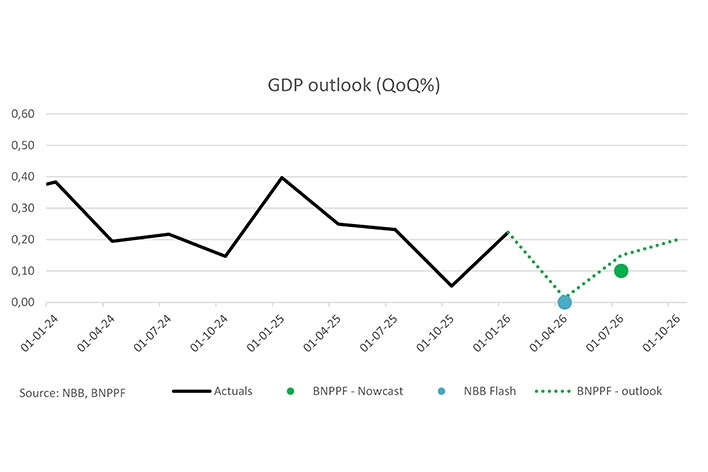
All in all, we are predicting 0.1% growth for the current quarter. A recession appears unlikely for now*. We will update our annual forecasts once the final national accounts for the second quarter have been released. At the moment, we are expecting to see GDP growth of 0.6% for this year and 1.0% for next year. The annual inflation rate should be 2.8% this year and 2.2% next year. Opinions on inflation rates vary widely at the moment, however.
Inflation is a major point of disagreement
This is confirmed by the figures presented by forecast aggregator FocusEconomics. Every month, they ask financial institutions, think tanks and other groups of experts for projections on e.g. inflation.
We already discussed the increased divergence in forecasts last year, when we were seeing ever-greater differences between growth projections submitted by the various participants in this monthly exercise.
Inflation is the biggest point of disagreement between economic forecasters right now. We’re over halfway through the year, and there is still a historic lack of agreement regarding the average by which they expect prices to increase over the course of the year. That’s quite remarkable.
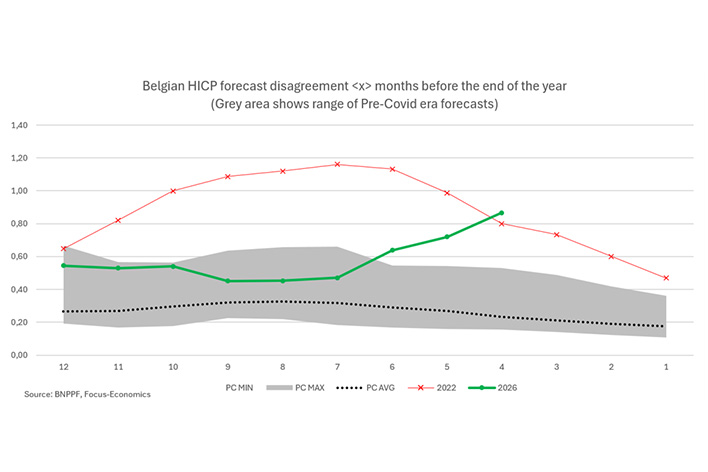
As shown by the black dotted line in the graph, (pre-COVID) inflation forecasts only disagreed by 0.3 percentage points on average at the start of a given year followed by a gradual decline through the year. After all, the more of a year has passed, the less there is left to disagree about.
Things were a bit different in 2022, when inflation reached a record high of 13.1% in the autumn. With a value that high there is more room for differing opinions, partly explaining the height of the red line.
Widely differing forecasts
Now it appears that the figures collected by FocusEconomics for its August edition vary even more widely than back then. While the consensus today is around 3% for total inflation in 2026, forecasts differ by almost a full percentage point on average.
That makes things tricky. For families, because they already find it hard to accurately assess price trends in the economy. For companies, too, as these are often required to index wages automatically without being able to pass on price increases to (foreign) customers in compensation. Finally, of course, it makes things harder for the government, which must once again go looking for billions with which to curb a growing deficit under these difficult circumstances. Three months to the US midterms: buckle up!
*If a flash estimate was zero in the past, this was still a useful sign. If we look at all flash estimates since 2008 predicting between -0.1% and 0.1% quarterly growth, the relevant quarters ultimately showed negative growth in 27% of cases. Today, 10% of our own models indicate a shrinking economy. In combination, we therefore estimate the probability of an ongoing recession since April as less than 3%: 27% chance of a contraction in the previous quarter x 10% for this quarter.