

Are US tariffs on Chinese products effective?
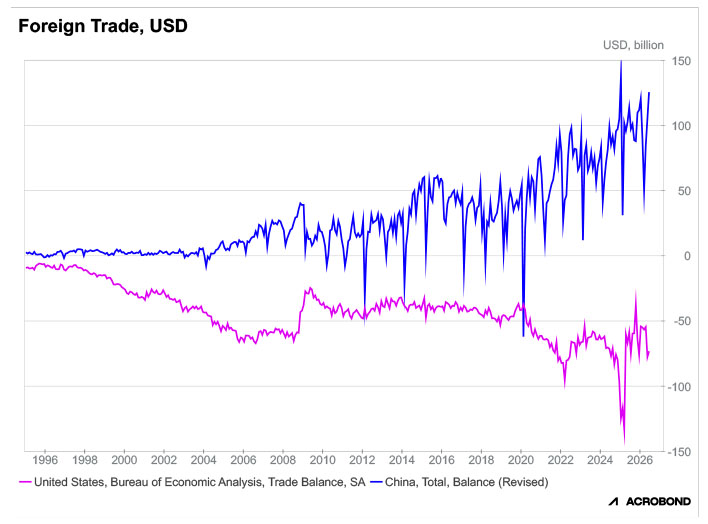
The tariffs that Donald Trump has imposed since his return as President of the United States in January 2025 are intended to reduce the US trade deficit. In the crosshairs: China. Has this tariff policy succeeded in restoring the balance between the US and China? Not really. After all, figures from June 2026 show that the US is still importing on a massive scale from abroad.

Trade war against China
Donald Trump’s return to the White House quickly brought the concept of a trade war back into the spotlight. Through a range of tariffs, he sought to reduce the massive US trade deficit, which at the time stood at around $70 billion per month. The measures – or rather, the threats – were directed at most of the countries with which the US had a trade deficit, but primarily at China.
China: a key player in globalisation
The figures are impressive. In 2001, China joined the World Trade Organisation (WTO), following no fewer than 15 years of negotiations. For China, this accession entailed a threefold commitment:
- To gradually reduce customs duties
- To open up its market further to foreign companies
- To respect international trade rules
This is often regarded as a major turning point in globalisation, as it accelerated China’s integration into the global economy and contributed to its strong economic growth in the decades that followed.
China’s impressive trade surplus
In 2001, there was no significant imbalance, as the trade balances of both economic giants were virtually zero. Since then, everything has changed at breakneck speed. When Donald Trump took office in January 2025, China recorded a surplus of $138 billion compared with $86 billion a year earlier. Enough to send the US president into a rage.
Since then, the trade war has been raging in full force, complete with numerous plot twists. Just to name one, when the US Supreme Court declaring the tariffs invalid, forcing the Trump administration to refund part of the improperly collected taxes.
A Chinese trade model geared towards exports
The Chinese model is built with the precision of a Swiss watch: you set a target, provide yourself with the necessary resources and achieve it. The objectives are set for the long term, without being overly ambitious in the short term. But everything moves resolutely in the chosen direction, regardless of the circumstances.
China is currently facing a major crisis in its domestic demand (a lack of confidence since Covid, a crisis in the property sector, an accelerating ageing population, and astronomical youth unemployment). As a result, it is forced to focus all its efforts on export markets in order to achieve its growth targets. China is producing on a massive scale, subsidising all sectors that need it with billions … and it’s working. Exports rose by 27% in the first half of the year!
US trade deficit persists
The results are staggering across many sectors: electric cars, batteries, artificial intelligence, etc. In June 2026, China had a trade surplus of $126 billion. Meanwhile, in the United States, it’s back to business as usual: buying ever more from abroad. Despite rising US oil and gas exports, the monthly trade deficit still hovers around $70 billion. The trade war has certainly succeeded with a vengeance in causing enormous uncertainty. But has it achieved its main objective? Clearly it has not.