

The Strait of Hormuz and exchange rates
The euro is weakening against the dollar. The reason? Diverging economic growth and inflation trajectories on either side of the Atlantic.

Highlights
- The euro ends the first half of 2026 weaker against the dollar.
- The gradual reopening of the Strait of Hormuz is easing concerns about inflation and interest rate hikes in Europe.
- However, the economic and political situation in the United States is entirely different, prompting markets to anticipate a stronger dollar.
Donald Trump’s victory in the November 2024 elections initially sent the dollar soaring, only for those gains to be erased by turbulence linked to threats of a trade war. Nevertheless, the foreign exchange market is once again taking centre stage.
Why is the euro falling against the dollar?
The euro has indeed weakened against the dollar, retreating to its summer 2025 level of 1.13 USD per EUR. The move is particularly counterintuitive, as the European Central Bank (ECB) raised its benchmark interest rates on 11 June 2026 specifically to curb persistent inflation across Europe.
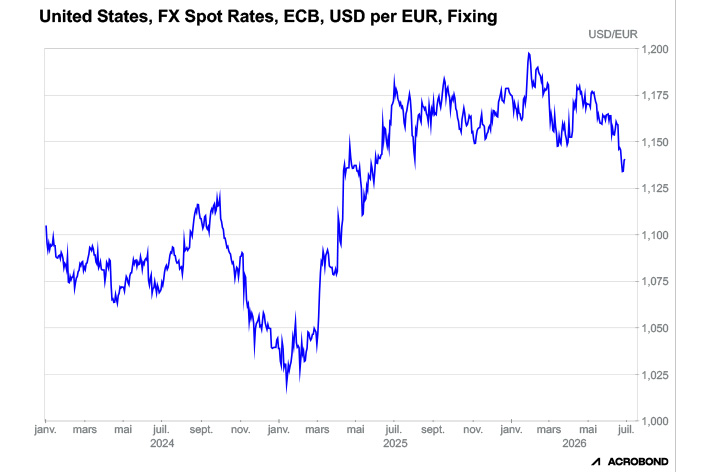
Since the Fed did not immediately follow the ECB’s lead, one might have expected this to support the euro’s exchange rate and lift the single currency against the greenback. Yet the opposite is happening. Why?
Europe’s businesses and investors are sensitive to exchange rates
Many European companies operating in the US - and investors who had opted for dollar-denominated investment - were stung by the dollar's decline in 2025, when the exchange rate abruptly jumped from 1.03 to 1.20. Now, the opposite is happening.
As so often, the main explanation lies in market expectations. Europe's economic struggles are no secret: growth remains weak, and the outlook is grim, particularly due to tensions in the Strait of Hormuz, which reignited inflationary pressures and dented business confidence. While the ECB did raise its key rates by 25 basis points, the situation in the Strait of Hormuz has since improved - and that changes everything. Fears of accelerating inflation have eased, and with them, expectations of further rate hikes in Europe.
United States: the weight of inflation
It’s a different story in the United States. Growth remains strong, businesses are confident, and investment in AI has reached such levels that no one is anticipating any real economic slowdown.
There’s no denying that some sectors are struggling, particularly those facing fierce competition from China. That said, most indicators remain positive. If inflation doesn’t ease quickly enough, there’s little doubt the Fed will tighten monetary policy. Donald Trump opposes this, but since he’s determined to cut inflation by November 2026 to fulfill his campaign promises, 1 or 2 rate hikes may still be on the table.
Towards a calmer currency market?
Historically, exchange rates between 1.10 and 1.15 tend to satisfy everyone. Deviations often spark tensions. From this perspective, the currency market appears to be heading toward calmer waters.