

Part 1: European pensions - Europe relies on a single pension pillar and it’s crumbling
The average statutory pension in the EU is projected to drop from 43% of wages in 2022 to 36% by 2070, according to the European Commission’s Ageing Report. In concrete terms: someone receiving €100 in pension today will see that shrink to around €84 within 2 generations. Europe has no safety net for this. In most member states, over 90% of pension income comes from the government. Expanding occupational pensions is therefore essential and it simultaneously addresses a second European challenge: the shortage of risk capital.

The maths behind an ageing population
Our statutory pensions operate on a pay-as-you-go system: today’s workers fund today’s pensions. Nothing is set aside; it’s a direct transfer. This works well as long as there are enough workers per retiree. But that ratio is now shifting dramatically.
In 2022, the EU still had roughly 2.7 workers for every person aged 65 or over. By 2100, that number will fall to just 1.5. Meanwhile, the old-age dependency ratio rises from 36% in 2022 to 55% by 2050. The baby boomers, born between 1946 and 1964, are now retiring en masse or have already done so. Compounding the ageing trend, the share of over-85s will double by 2050.
More holes in the bucket
Imagine a bucket with more and more holes appearing at the bottom, while the tap above gradually closes. The bucket is slowly emptying. Current retirees receive, on average, twice as much in lifetime pension payments as they contributed during their working lives. Reforms following the 2008 financial crisis reduced this ratio to roughly 1.5 for younger generations. But even that ratio is becoming difficult to sustain due to an ageing population.
2 levers
Governments have 2 levers: higher taxes or lower benefits. In Europe, the first lever has little room left to manoeuvre. Government revenue already stands at over 51% of GDP in France, nearly 50% in Belgium, and 48% in Germany. Moreover, many member states are burdened by high public debt. While longer working lives and higher employment rates (particularly in Belgium) could help, they certainly won’t solve the problem.
But there is a second lever: the replacement rate. This is falling from 43% of previous earnings to 36%. The decline occurs because pensions in many countries are automatically adjusted, for example, as life expectancy increases. Additionally, pensions are rising more slowly than wages. In Greece, Poland, Portugal, and Spain, the replacement rate even drops by 16 percentage points to 23%. In Belgium, however, it holds up remarkably well, declining only modestly from a solid 46% to 43%. These figures, however, do not yet account for recent pension reforms.
A one-legged stool
An ideal pension system rests on three legs: state pensions, occupational pensions, and individual savings. Europe’s system stands on just one leg. In France, Spain, and Portugal, 98% of pension income comes from the government; in Belgium, it’s 91%. The very leg bearing the most weight is being shortened. The result: stability is lost.
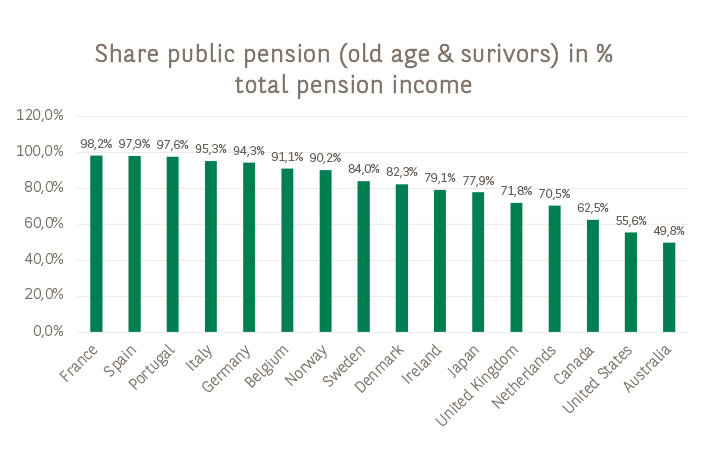
Source: The New World Economy, Ageing Vulnerability Index 2026 (based on OECD data) · statutory old-age and survivors’ pension.
The exceptions prove the rule. The Netherlands, with its well-developed occupational pension funds, derives only 71% of pension income from the state pension. In the United States and Australia, this figure is barely half. There, a second pillar absorbs much of the impact.
Savings account vs stock market
Over-reliance on state pensions is not just a problem for retirees; it also weakens the European economy. A pay-as-you-go system builds no capital. A funded system, like an occupational pension, does. Every euro is invested for decades. Countries with strong supplementary pensions therefore have deeper capital markets and more households investing.
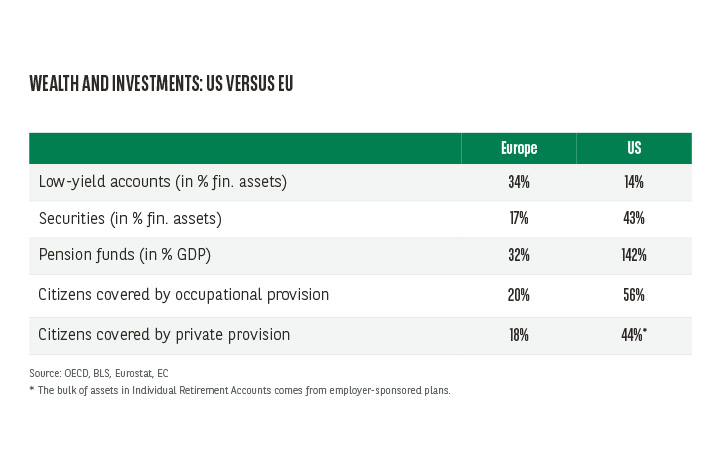
The difference is stark. US pension funds manage over 140% of GDP, while European funds barely reach a third. A significant share of American venture capital for growth companies comes precisely from these pension funds. In Europe, a third of household wealth sits in low-yield accounts, earning little for savers and even less for the economy.
In part 2, we delve deeper into the strengths of occupational pensions… and why Europe’s second pillar remains so underdeveloped.