

How reliable are confidence surveys these days?
Markets tend to scrutinise confidence surveys closely to assess the economic climate and attempt to predict future trends. However, for some time now, their relevance seems to be waning. The issue at stake: widening income inequalities, which are influencing perceptions of the economic situation.
Confidence indicators out of step
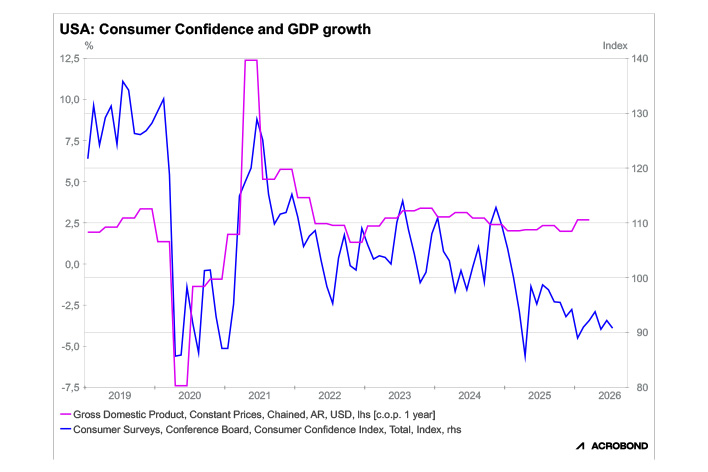
In the US, for example, economic growth is close to 2% for some time now, buoyed by consumer spending and massive investments in artificial intelligence. Yet confidence indicators are suggesting that consumers are concerned, particularly because of the level of inflation.
At present, the two main consumer confidence surveys – those conducted by the Conference Board and the University of Michigan – are at low levels. These levels are typical of a recession, even though growth is strong.
Historically, lower confidence readings have been recorded only three times over the last three decades:
- During the stock market crisis of 2001
- At the time of the 2008 global financial crisis
- During the COVID-19 pandemic that broke out in 2020
Does falling confidence signal a recession?
A similar discrepancy can be seen in business confidence indicators. Since the pandemic began, the ISM (Institute for Supply Management) surveys of manufacturing firms and the services sector have repeatedly signalled a recession, which has never materialised. These monthly surveys fuel discussions in the media and on Wall Street. But this media overexposure is becoming increasingly difficult to understand, as these results seem so outdated.
Why are trust surveys outdated?
One possible explanation lies in the impact of social networks on public morale. There, you’ll meet brilliant, fulfilled people who share their happiness and their “wellness” tips. However, we now know that these messages can undermine followers’ morale and reinforce feelings of pessimism about our own financial situation.
Furthermore, we cannot rule out the possibility that the survey results may be skewed by rising inequality. Unlike aggregate GDP growth figures, surveys give equal weight to each response, while growth is increasingly dependent on spending by a few. This observation no doubt applies to surveys of businesses as well: the giants on the one hand, and SMEs on the other.
Confidence surveys: a reflection of inequalities
In the US, it is estimated that the wealthiest 10% account for half of consumer spending, compared to a third three decades ago. It can also be seen that regardless of the level of inflation or the unemployment rate, US growth in 2026 under Donald Trump is almost the same as in 2024 under Joe Biden. Yet, according to the Gallup survey, which reflects public confidence in the economic climate, the Democrats consider the situation to be very bad (the index rose from +7 to -76 in 18 months), while for the Republicans the index jumped from -42 to +41, illustrating real optimism for the current economic landscape. Depending on the President’s political party (and no doubt on his personality as well), confidence in the future is therefore experienced very differently even in a similar economic context.
This may explain why confidence indices do not accurately reflect reality. In the end, it’s all a matter of perception.
Stock markets influence confidence
Recently, confidence has begun to rise amongst high-income Americans thanks to the remarkable rise in the stock markets. Conversely, however, it has deteriorated amongst low-income consumers, who are being worn down by higher inflation. The Gallup Institute also reveals that the proportion of consumers who say they are in a difficult situation due to inflation has risen since the pandemic, from 10% (between 2005 and 2021) to 40% since the war in Ukraine.
The Federal Reserve is also beginning to question the value of the forecasts from these surveys. As former Chairman Jerome Powell used to say, Americans continue to express ‘pessimistic’ views on the economy ‘and then go and buy a new car’.
The gloomy results of the confidence surveys undoubtedly reflect a certain degree of frustration at the genuine shortcomings of a system that many regard as favouring the wealthiest and large corporations. Consequently, unless the financial system changes to become more equitable, surveys of economic sentiment will continue to lose their predictive power.