

Belgian public debt: how does it compare with Denmark?
It is impossible to switch on the radio or open a newspaper without coming across discussions about public finances and how to strengthen the public finances. The negotiations and trade-offs aimed at closing the ever-widening gap between revenue and spending reflect competing priorities, leaving everyone dissatisfied. So, what is really going on? What is the problem, and how can we make sense of it?
Belgium and Denmark: similar tax burdens
To understand the scale of the challenge, we have chosen to compare Belgium’s public finances with those of a fairly similar country in terms of tax burden: Denmark. Denmark has 6 million inhabitants, compared to Belgium's almost 12 million, and is spread across an area of approximately 43,000 km², compared with Belgium’s 30,000 km².
The latest OECD report confirms that the tax burden is similar in both countries, meaning that people pay roughly the same amount of tax. It is worth pointing out that comparing tax systems is a complex exercise. As the cost of living is largely determined by local circumstances, the broader picture must be taken into account. Nevertheless, we have attempted such a comparison and identified several findings that merit reflection.
The tax burden is significant in both countries, particularly when it comes to employment income. Businesses pay broadly similar levels of tax; wealth taxation is around half as high in Denmark as in Belgium, while VAT is higher. Overall, tax revenues amount to around 45% of GDP in Denmark, compared with 43% in Belgium. Therefore, it is fair to say that the overall tax burden is comparable.
Looking at public debt differently
We are constantly told that Belgium’s public debt is becoming unmanageable, and that rising interest rates linked to inflation could trigger a “snowball effect”, forcing the government to borrow even more just to pay the interest on its debt. So, how do the Danes manage things?
In Denmark, public debt stands at around 30% of GDP, compared to 110% in Belgium. How is this possible? Put simply, spending is broadly aligned with revenue, meaning budget deficits remain limited even when economic conditions deteriorate. In other words, the country does not live beyond its means.
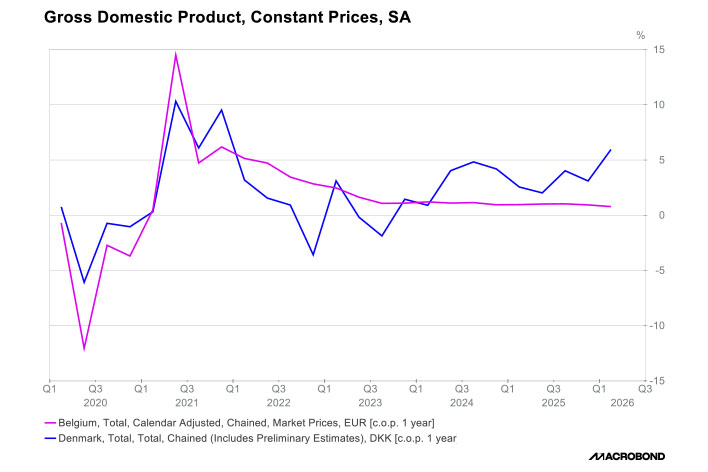
If we look at debt per capita rather than as a percentage of GDP, Belgian public debt amounts to around €60,000 per person, compared to €20,000 in Denmark. Economic growth is also significantly stronger there: +5.9% in the first quarter of 2026 compared to just 0.8% in Belgium.
Public spending in Denmark also appears to be more carefully targeted, with greater consideration given to citizens' views than in Belgium. Unemployment is also significantly lower, partly thanks to a system of personalised support and coaching for people who lose their jobs. The result is striking: an unemployment rate of 3.1%, compared with 6.2% in Belgium.
Food for thought!