

AI: an engine of economic growth?
The importance of AI investment for US growth was already clear last year. The National Bank of Belgium’s (NBB) latest figures on 2025 investments in our country confirm a similar positive trend. Moreover, Belgian businesses and individuals are spending increasingly more to access the most advanced LLMs.

The US economy is reaping major benefits from AI expansion
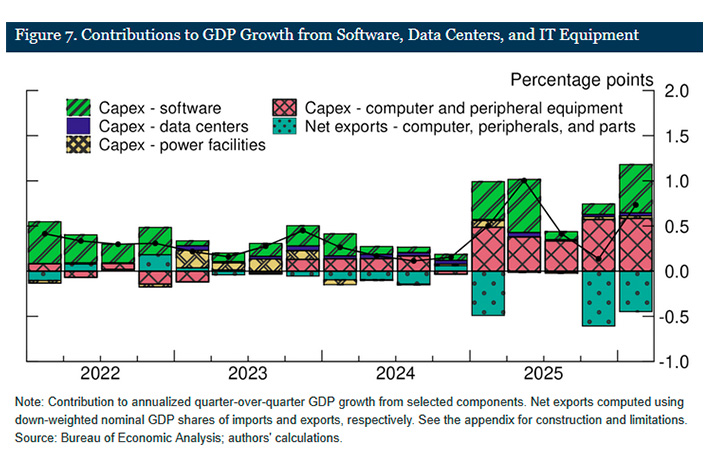
The chart below shows the contribution to growth of investment in software, data centres, electricity infrastructure and computer equipment in the US. Together, these accounted for around 1 percentage point of annual GDP growth in the second quarter of 2025. In the first quarter of 2026, this contribution still stood at 0.73 percentage points. Note: without adjusting for imports of computers and related equipment, the latter figure would have been 1.18 percentage points. Much of the AI-related hardware is, after all, manufactured outside the US.
What about Belgium?
The authors of the chart take a broader approach than Jason Furnam. Last year, this American economist calculated that AI-related spending accounted for almost all growth in the first half of 2025. He included computers and hardware, telecommunications, and software/databases as relevant assets, and calculated how much was invested in them.
Based on the latest updated NBB data, we can replicate the exercise for Belgium. The results show that in 2025 - the last year for which figures are available - AI contributed around 0.2 percentage points to total growth of 1%. This represents a slight slowdown compared with 2024, but remains significant, especially when compared to the total contribution of business investments.
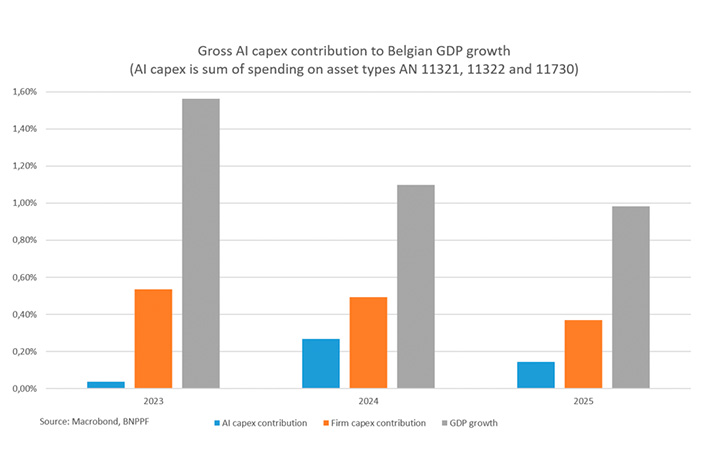
As in the US, it is important to note that a large proportion of investment goods are not manufactured domestically. The associated imports, for which no figures are currently publicly available, must be deducted to determine the net effect on economic growth. This also applies to companies' 'traditional' investments.
AI adoption in Belgium
There is no doubt that artificial intelligence is having an increasing impact on the Belgian economy. According to Statbel, 34.5% of businesses were already using at least one AI technology in 2025, compared with just 13.8% 2 years earlier. In large companies, this figure rises to around 75%. Applications that analyse written language are particularly popular: nearly a quarter of businesses use them. These figures relate to businesses with at least 10 employees.
What this rapid adoption means for the labour market remains uncertain for now. A recent study by Gert Bijnens, Anders Humlum and Stijn Vanormelingen offers food for thought. Using Belgian data, the researchers show that investment in new machinery primarily creates additional demand for highly skilled workers at external suppliers, and much less at the investing companies themselves. We may see something similar with AI: companies do not necessarily need to hire their own AI specialists if they can access the technology through external providers.
Businesses are opening their wallets … and households too
Our own payment data also show the growing importance of AI. We examined payments made by BNP Paribas Fortis business customers to providers of AI models and services. Significant differences between sectors stand out. This was also the case during the previous digital revolution a few years ago. Back then, it took much longer for construction companies and businesses in the hospitality sector, for example, to make having their own website the norm. Digital companies (software developers, IT consultants, etc.), meanwhile, were ahead of the curve. Today, those same digital companies make payments to the 2 largest model providers most frequently. Over the past 12 months, the amount spent by Belgian companies in our sample has increased fourfold.
Interestingly, the same trend is now emerging among private customers. The chart below shows the percentage of individuals analysed who pay to access models from either of the 2 providers. Here too, we see a sharp increase over the past 12 months. However, this proportion remains well below that of payments for video or audio streaming subscriptions.
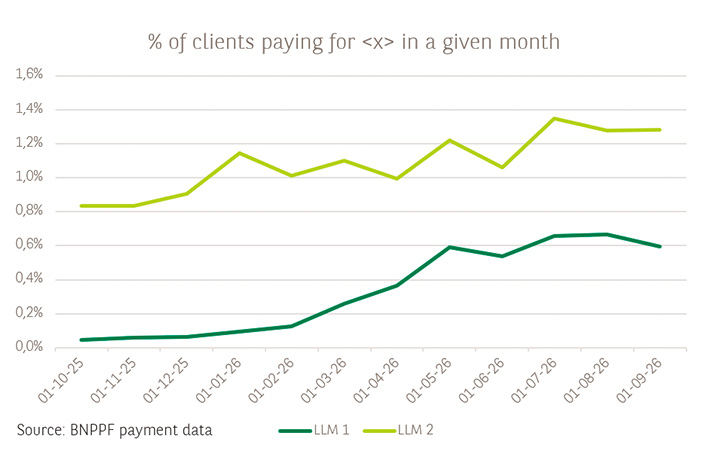
AI therefore appears to be gaining ground not only in the workplace, but also in everyday life. More and more users seem willing to pay for applications that barely existed a few years ago. A fact that LLM developers are naturally keen to highlight when promoting their upcoming IPOs.