

War in the Middle East increases the risk of a recession
The violence in the Middle East is taking a heavy human toll. The ongoing threat of drones and explosives is significantly disrupting the transport of fossil fuels in the region, leading to higher gas and oil prices. It remains difficult to predict whether or when a ceasefire will be reached. Nevertheless, based on scenarios developed by our colleagues in London, we can assess the potential impact on the Belgian economy.
Temporary spike vs. prolonged pressure
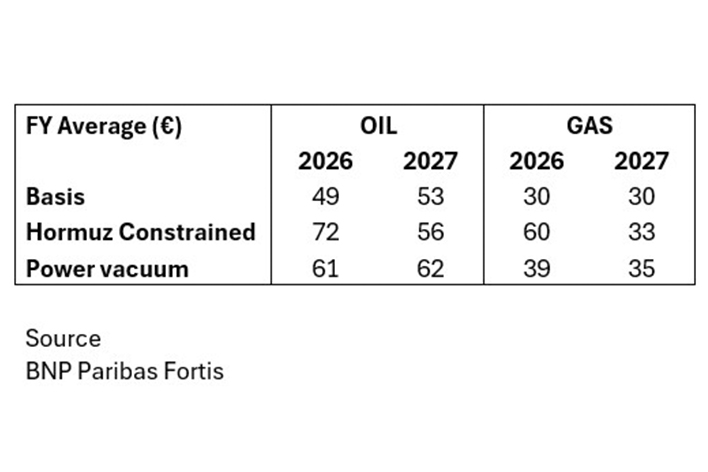
For our analysis, we use oil and gas price assumptions derived from a baseline scenario and two more adverse scenarios:
- Hormuz Constrained: fossil fuel prices rise sharply for a relatively short period, but return to previously expected levels after just over a year.
- Power Vacuum: a prolonged period of persistently higher prices, albeit with lower peaks than in the previous scenario.
In both scenarios, the appreciation of the euro against the dollar is delayed by around six months. This reflects a typical “flight to safety”, which tends to strengthen the dollar.
The table below summarises the impact in terms of annual average prices (in euros) for both oil and gas.
Food prices
We also expect food prices to be significantly impacted. However, the increase is likely to be more limited than at the start of Russia’s invasion of Ukraine, when food inflation remained above 5% for almost two years. We currently anticipate around 12 months of elevated food inflation.
Under a Power Vacuum scenario, overall inflation would reach 2.4% this year, compared with our pre-war forecast of 1.9%. In a Hormuz Constrained scenario, inflation would rise to 3.3%.
Growth: slower, but not necessarily negative
Our colleagues also modelled the potential impact of the conflict on GDP growth in developed economies. The chart below shows the Power Vacuum scenario on the left and the Hormuz Constrained scenario on the right.
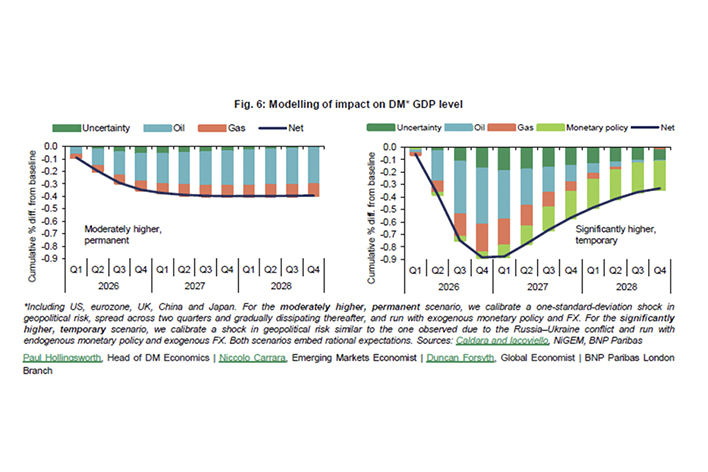
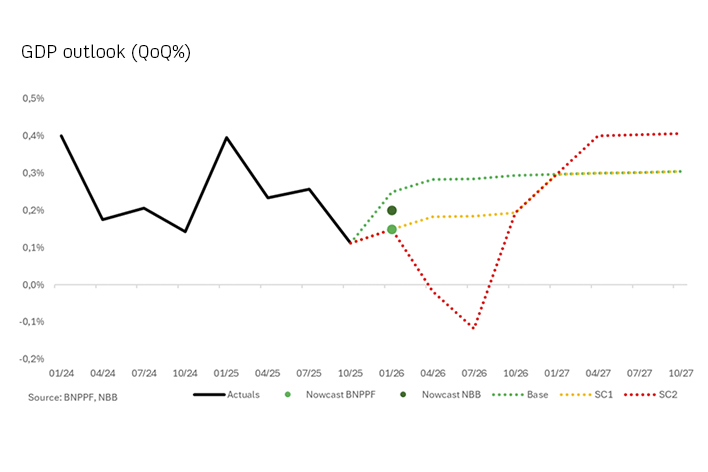
When we apply these to the Belgian economy, both scenarios closely align with our latest nowcast, which indicates quarterly growth of just 0.15%.
Under the 'Power Vacuum' scenario (shown in yellow in the chart below), Belgian growth slows to 0.7% this year and 1.1% next year. In the Hormuz Constrained scenario, growth weakens further, reaching 0.4% this year and 1.0% next year. In this scenario, the economy also enters a short-lived recession in the next quarter.
As always, these forecasts are based on the information currently available.