

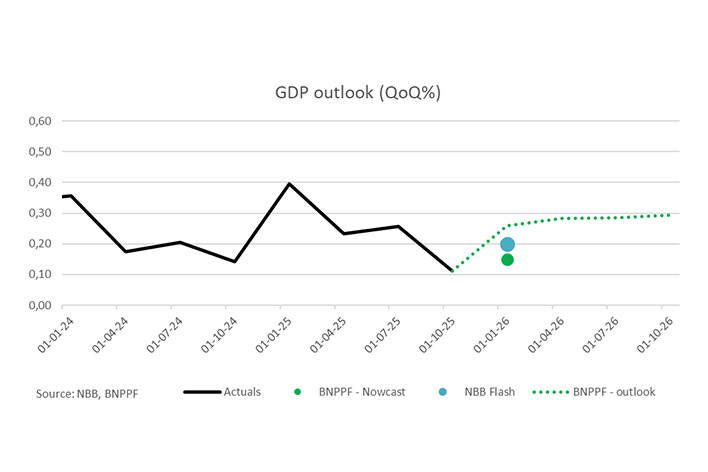
Nowcast Q2 revised: 0.15%
Economic growth in our country slowed sharply in the fourth quarter. This slowdown is reflected in our latest nowcast for the first three months of this year. Traditional indicators and our bank index point to sluggish growth. Recent international events have added further pressure since early March, although we do not currently expect a recession.

Optimistic consumers
First, the good news: Belgian consumers are currently optimistic. Perhaps even slightly too optimistic, particularly regarding the cooling labour market. We previously highlighted the fact that Belgian households expect unemployment to fall in the coming months. In this respect, they differ from our own assessment and from the situation in neighbouring countries.
It is clear that the unemployment rate, like inflation, remains relatively low. In addition, momentum in the property market is increasing again, after rising interest rates dampened the enthusiasm of potential buyers for several quarters. The national accounts for 2025 once again show that households remain the driving force of the Belgian economy. Of the total GDP growth of 1.0%, no less than 0.9 percentage points came from private consumption*.
Businesses are less positive
The situation is much less positive for businesses. According to the latest barometer, overall sentiment has fallen to its lowest level in 10 months. With the exception of the construction sector, conditions worsened across all sectors. Trade even reached its lowest level in 20 months. Service providers and manufacturers are also more pessimistic than at the start of the year.
Our bank index confirms this trend. Based on the anonymised, aggregated banking transactions of our corporate clients, we are able to monitor activity across different sectors of the economy. Overall, these figures reflect the cooling economy at the end of last year. More worryingly, the recovery seen during the first few weeks of January ended around the spring half-term holiday.
Slow growth with downside risks
Taken together, the current models estimate low quarterly growth. The median estimate is 0.15%, while the average is even lower at 0.13%. In addition, this nowcast is based on data from the first two months of the current quarter. It seems likely that the conflict in the Middle East will affect the figures that will be released later this month.
* Private consumption did not increase in the fourth quarter, after remaining subdued during the late summer period.