

The lost battle of protectionism?
The United States is preparing to impose significant tariffs on many imported products in a bid to strengthen American industry and “Make America Great Again.” But do we still live in a world where such measures work? Not so sure!

With the excitement of the US elections barely over, the next question has already come to the fore: how to respond to Donald Trump’s determination to protect American industry by imposing tariffs on all imported goods?
It’s a question on everyone’s lips because the United States is Europe’s biggest trading partner, making the stakes exceptionally high.
On closer inspection, it’s understandable why the US would want to try to reduce its ballooning trade deficit, which now approaches $100 billion per month. This desire is all the more understandable given global fears of being flooded with heavily subsidised Chinese products at a time when China is desperately trying to revive its stagnant economy.
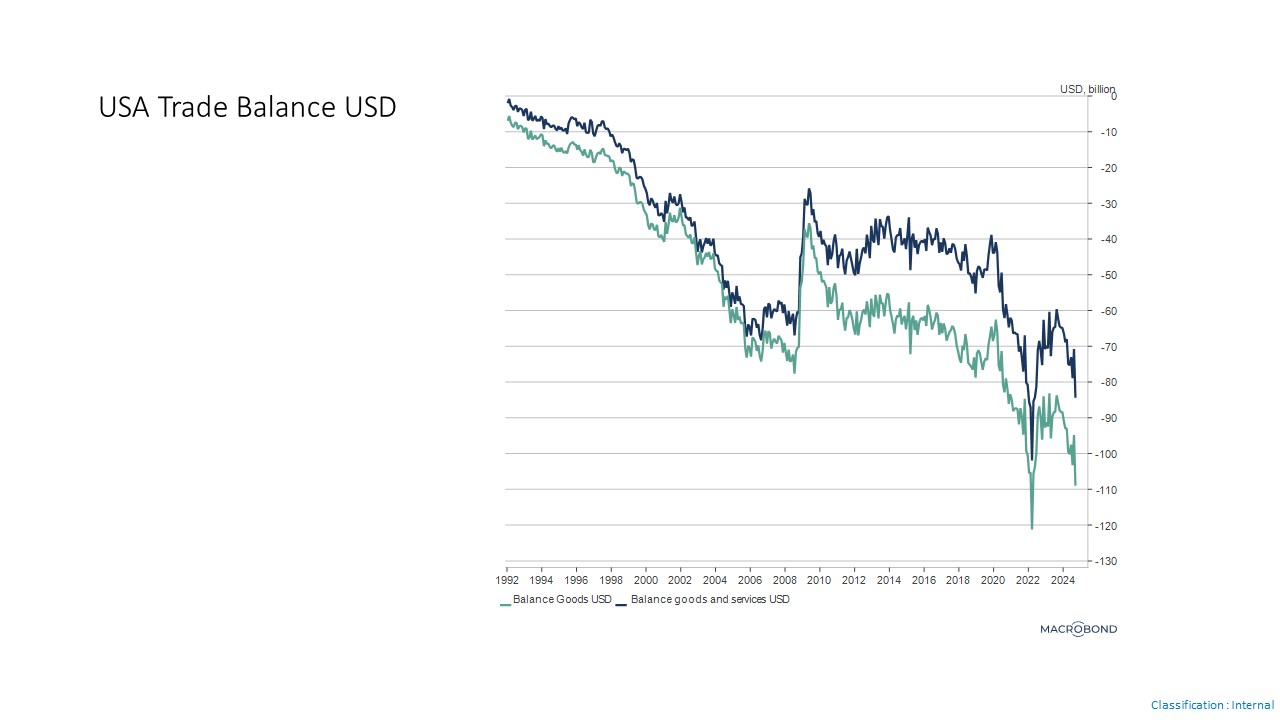
The relentless deterioration of trade balances
Looking at historical data, one might wonder whether the world we live in today still supports such protectionist policies. During his first term, Donald Trump had already imposed tariffs on more than 200 products from Europe and especially China (for example, a 30% tax on aluminium and steel in 2018). However these measures failed to halt the slow decline of the US trade balance. In fact, only a few months after the introduction of these import taxes, business confidence indices had deteriorated noticeably, as many executives realised they would be the first victims of the new tariffs.
Nevertheless, Donald Trump campaigned on a return to protectionism, and it remains to be seen what form this will ultimately take.
What impact on Europe?
If the United States does embark on another wave of protectionism as Trump envisages, should Europe follow suit and retaliate in kind? The US mainly imports pharmaceuticals, cars and luxury goods from Europe, while it exports oil products and gas to the continent. It’s far from certain that tit-for-tat responses would be easy in this context, especially if Europe wants to avoid triggering a new bout of inflation.
The year 2025 already promises to be challenging for Europe, which will have to manage its own defence policy in a tense geopolitical climate. France and Germany are also entering 2025 with significant political uncertainty, and history shows that when this duo struggles, decision-making becomes even more complicated. But Europe will have to act, as the challenges are many!
To be continued…