

The impact of AI on economic activity
Artificial intelligence is now an integral part of our everyday lives. But which areas are most affected? The impacts of AI are felt differently across sectors. So, which fields are evolving the fastest? Companies in the most competitive sectors, like parcel delivery services, online shops, and digital platforms, have the most to gain by adopting AI quickly.

As AI delivers new innovative applications almost daily, economists are analysing its potential impact. However, opinions differ greatly. A recent report from U.S. investment bank Goldman Sachs estimates that AI could boost GDP growth by 9% – equivalent to nearly 1% annual growth. This forecast is encouraging compared to Belgium’s expected economic growth of 1.1% this year.
Nobel Prize-winning economist Daron Acemoğlu takes a different view. He predicts AI will result in only minimal productivity and growth gains – no more than half a percentage point over ten years. These very different outlooks are based on assumptions about integration, automation and other factors. Even at the microeconomic level, drawing firm conclusions remains highly complex.
One recent study looked at the impact of AI on a group of programmers. The use of GitHub Copilot, an AI coding assistant, led to individual changes in work behaviour. Programmers spent more time on essential tasks and focused more on evaluating alternative solutions. Interestingly, less-skilled coders saw the biggest improvements in efficiency, with the weakest performers benefiting the most.
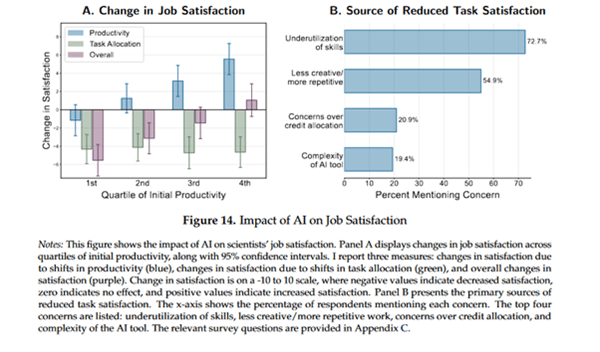
Another study focused on the behaviour of scientists in a research and development lab. Researchers using AI discovered 44% more materials, filed 39% more patents and created 17% more innovative products. Surprisingly, the least productive researchers were barely affected, while the top performers became twice as productive. However, this increase in output didn’t make them any happier.
The broader impact of AI
Prominent US economist Tyler Cowen has a different perspective. He argues that the most competitive industries are those most affected by AI – not public institutions or educational institutions, but sectors where intense competition drives innovation.
In Belgium, this perspective is consistent with the statistics on business failures by sector. While the current figures still reflect the aftermath of COVID and lockdowns, we can analyse survival rates across sectors.
The average survival rate of the companies in the panel*, which stood at 90% after one year, dropped to just 65% after five years. However, these figures hide significant differences between sectors.
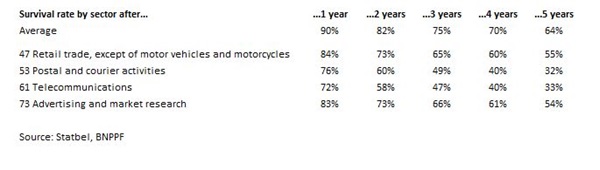
Four sectors stand out negatively: retail (including online shops), postal and parcel delivery services, digital platforms and marketing specialists. According to Tyler Cowen, these particular sectors should swiftly integrate AI into their processes.
*For this exercise, only sectors where each sector/year under consideration had at least 100 companies were included.”