

Labour market in transition
The labour market in our country has been cooling for some time. Nevertheless, the De Wever government wants to get more people into work. The fact that more inactive people are looking for work and are also finding jobs is an encouraging sign.

The Belgian labour market remains a key area of focus for this government. Currently, our employment rate is significantly lower than in the Netherlands and Germany. Increasing this percentage would benefit the budget by reducing benefit payments to unemployed people while also increasing revenue from labour-related taxes. However, this is not straightforward in a cooling labour market.
Gradual cooling
The Federgon index for temporary employment has been declining for some time. As a leading indicator, it provides early signals when the labour market starts to cool. The cooling trend began in 2017, if we disregard the dip caused by the lockdown during the pandemic. Job creation followed a similar path over the same period. Most of the growth came from self-employed workers and non-market-oriented functions.

This gradual cooling continues today. Recent figures from Statbel show that the vacancy rate is falling further. This figure shows the percentage of jobs in our country that remain unfilled. For permanent positions, this equates to approximately 130,000 open vacancies*. This is the lowest level in more than four years. Two thirds of these vacancies are to be found in Flanders.
More people in work
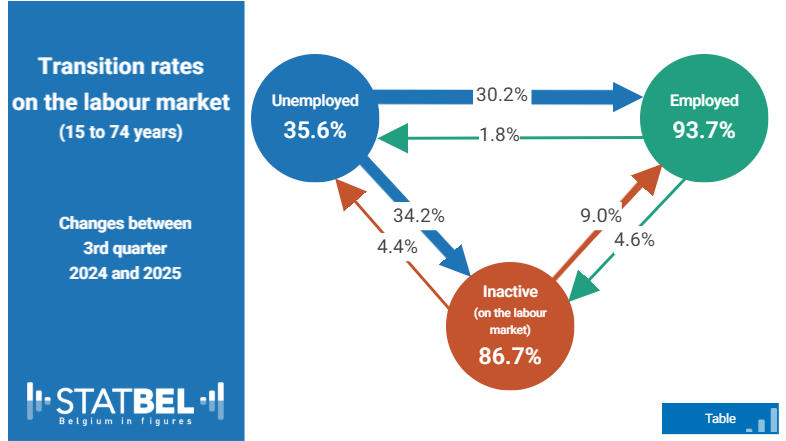
Despite the cooling labour market, the De Wever government still aims to get more people into work. In this respect, Statbel’s quarterly transition analysis sends an encouraging signal.
Transitions in the labour market | Statbel
Of those who are working, 94% are still in work one year later. Some 7.5% are employed by a different employer, usually within the same sector.
The analysis also shows that, according to the latest figures, more inactive people – a group mainly made up of retirees and students – are in work one year later. Nine per cent of people in this group find a job within 12 months, while 4 per cent become unemployed. It is these transition figures that will show, in the coming quarters, but more likely in the coming years, whether the labour market policy pursued is successful.
Which sectors are finding it difficult to recruit staff? Sixty per cent of vacancies are concentrated in four sectors: trade, industry, construction, and scientific and administrative services. The largest number of vacancies, combining temporary and permanent positions, is found in non-market-oriented services. The need to recruit in this sector, which is generally referred to as ‘the government’, is mainly due to its size. With a vacancy rate of just over 3%, this is barely half the level seen in the construction sector.