
Is the future of the labour market increasingly female?
Over the past two centuries, the Belgian economy has evolved from an agricultural economy to an industrial one, and eventually into a knowledge economy. Education has become increasingly important. Today, highly educated workers dominate the labour market, and the majority of them are women. Yet their catch-up process is not complete when we look at leadership positions within companies, despite the growing number of female entrepreneurs.

The future of the labour market: more female entrepreneurs?
A brief history lesson
The Belgian economy has changed profoundly over time. Belgium’s economic story began almost 200 years ago. At that time, the majority of the population worked in agriculture, the primary sector.
The Industrial Revolution dramatically altered this picture. By the end of the 19th century, industry had taken over. Construction and manufacturing became key engines of employment in the secondary sector. At the same time, rising productivity and expanding trade meant that fewer people were needed to provide food for the population.
Despite two world wars, technological innovations continued to generate strong productivity gains in the primary sector. As a result, more and more workers became available for the rapidly expanding service economy, the tertiary sector. Today, the services sector still provides the majority of jobs and accounts for the largest share of Belgium’s Gross Domestic Product (GDP).
Education is becoming more important
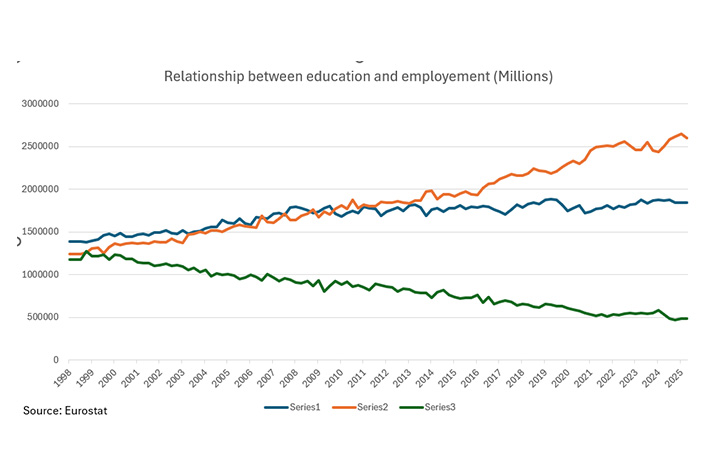
The increasingly complex range of tasks carried out by engineers and knowledge workers in the modern economy has reshaped the profile of the Belgian workforce. Around the turn of the century, the largest group was still low-skilled workers. From 2005 onwards, however, medium-skilled workers took over that role. A little more than a decade later, just before the Covid pandemic, highly educated workers had become the largest group in the labour market. The majority of them, around 1.7 million, are women.
A catch-up movement for women
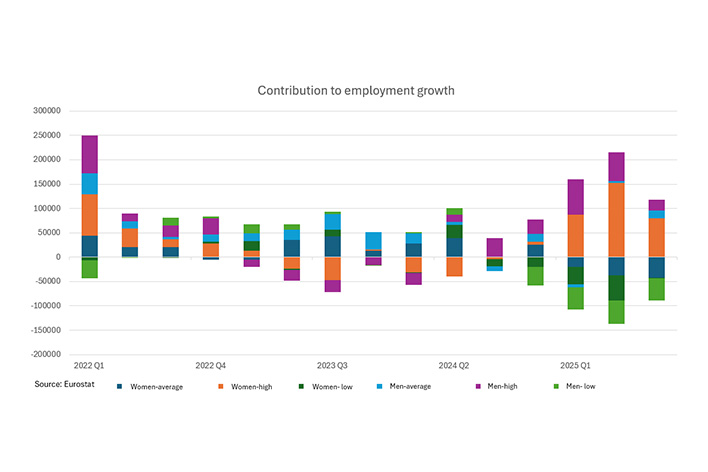
Although the gender pay gap and the glass ceiling have not disappeared entirely, today more than 1.4 million highly educated women play a leading role in the Belgian labour market. This group is making a particularly strong contribution to the De Wever government’s ambition to increase the employment rate. Of the almost 120,000 people who have found employment in the past 12 months, nearly 80,000 were women.
A delayed effect
At the same time, female board members remain a minority. The proportion of Belgian companies with at least one female board member has remained almost unchanged in recent years, hovering just below 40%. Furthermore, digital companies, which grow much faster than average, have even fewer female board members: barely 20% of these companies have at least one woman on their board.
The reasons are not clear-cut, but rather a combination of historical, cultural, and structural factors. Despite the large influx of women into the labour market, therefore, a gap therefore remains visible today.
More female entrepreneurs
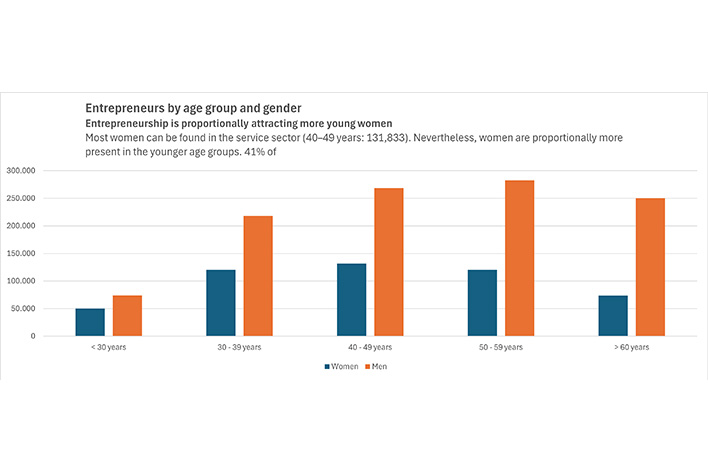
More encouraging, however, is the strong increase in female entrepreneurs in recent years. As AI reshapes the traditional economy, jobs in both the private and public sectors increasingly appear to be outsourced to self-employed workers. The number of self-employed people in the Belgian labour market has steadily increased over the past 20 years, even during the Covid pandemic.
Recent figures also show that the percentage growth in female self-employed entrepreneurs is consistently higher each year than among their male counterparts. It is also striking that among younger cohorts under the age of 30, the gender gap in entrepreneurship continues to narrow.
Will the future belong to self-employed women?