

Is Germany’s economic engine 2.0 back on track?
The GDP figures for the third quarter, published this Thursday, confirm that the German economy remains sluggish. Despite efforts by Chancellor Friedrich Merz, the long-awaited upturn has yet to materialise. Meanwhile, business leaders are beginning to show signs of impatience.
So, is Germany’s economic engine 2.0 really back on track? That’s the question following disappointing results in the German automotive sector: colossal losses at Porsche followed by a major strategic rethink, and a similarly bleak outlook for the entire VW Group, which posted its first loss since the dark days of the Covid crisis. And yet the new Chancellor had made an energetic start to his term, raising hopes across Europe.
Frustration and growing doubts from business leaders
What went wrong? At the start of the year, optimism was high. Everything suggested that Germany was finally emerging from its longest period of economic stagnation since the Second World War. Friedrich Merz had promised to invigorate Europe’s largest economy by amending the so-called 'debt brake' enshrined in the constitution. This would allow the government to establish a €500 billion fund for rebuilding infrastructure and increasing defence spending. However, just a few months later, doubts have emerged and frustration is growing in the business world.
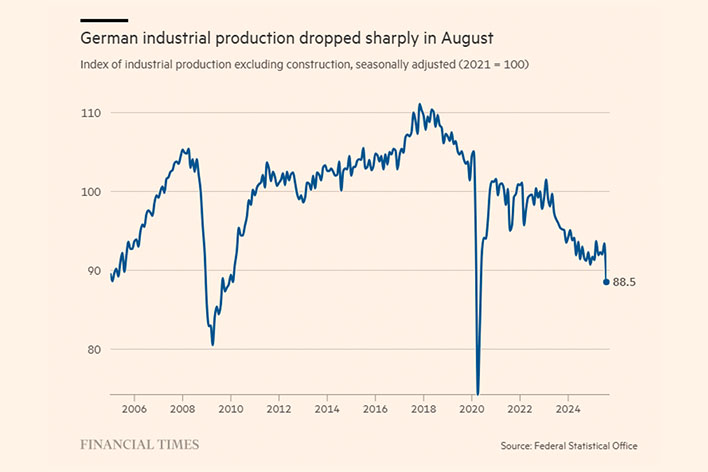
The third-quarter GDP figures, published on Thursday, confirm that the German economy remains weak. After shrinking over the past two years, the IMF now expects the country to record growth of just 0.2% this year, the slowest rate among major advanced economies. Unemployment has also risen slightly since January and now stands at almost 3 million, its highest level in 14 years. Industrial production fell sharply in August. A chart published by the Financial Times caught our attention, showing that German industrial output has fallen below 2006 levels. There is clear cause for concern.
Urgency and promises of recovery
Business leaders are becoming increasingly doubtful that the Chancellor’s strategy will succeed in the short term. Although the prospect of fiscal stimulus has bolstered the German stock market and raised medium-term growth forecasts, even amid a deteriorating global economic outlook, progress remains slow. Several projects may be ready on paper, but it will take time to implement them. There is growing scepticism over the state’s ability to release funds quickly or direct them towards projects that will genuinely boost productivity.
A last line of defence against the far right
Companies are also concerned that internal disputes within the coalition could undermine the structural reform agenda. It is no secret that Germany has been weakened since Russia’s invasion of Ukraine, which effectively ended the era of cheap energy for German industry. At the same time, companies are facing a wave of Chinese goods that have been diverted from the U.S. due to tariffs imposed by Donald Trump.
Even the Chancellor himself now admits that his government represents the last opportunity for the political centre to halt the far right's rise to power. Europe needs a strong, growing Germany, but the challenges are immense and time is short. The engine must stay on track.