

Does AI mean the end of teamwork?
Existing AI applications help us execute tasks faster. But they’re more than just a labour-saving technology. An experiment at a major Fast Moving Consumer Goods (FMCG) company shows how an individual, with the support of AI, can deliver work that is just as good as a team without this technology. What stood out is in this experiment is that the meaningful ideas that benefit the entire company are submitted by a team + AI combination much more often.

Vast amounts of money are spent on developing and implementing AI applications. Many business cases focus on the potential to save time and therefore work. Smart chatbots can take care of ever more significant parts of the service. Text-to-video applications speed up ad production. And Large Language Model (LLMs) tout themselves as an accelerator for white-page syndrome patients.
But can AI also improve output quality?
Together we’re stronger!
Wharton and Harvard University researchers conducted a large-scale experiment at Procter & Gamble. They hosted a workshop where company employees developed product ideas and packaging and distribution strategies for their business units, including baby products and oral care. Participants were randomly divided into four groups: Individual working without AI, Individual working with AI, Team of 2 working without AI and Team of 2 working with AI.
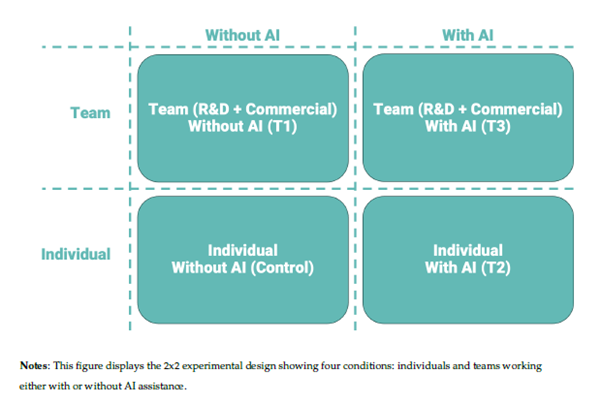
Each group was given the same task: to develop a new product idea for a real case from P&G. The best ideas were then presented to the multinational's management for validation.
First conclusion: an individual working with AI on average achieves higher quality than a team of two without AI. This is significant. A digital assistant/gen AI would therefore outweigh the benefits of teamwork. In addition, two-person teams (with or without AI) saved less time than their individual counterparts with or without AI.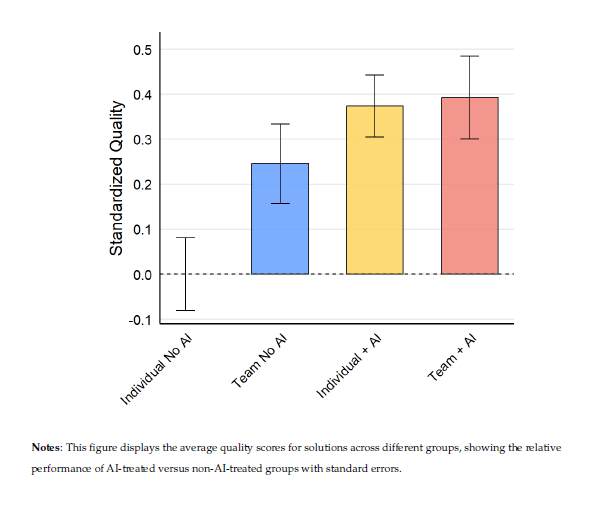
Novice + AI = expert?
A second point is perhaps even more intriguing: using AI, employees without product development experience produced concepts that matched the output of teams of experienced specialists. The researchers observed this in the individual + AI group without relevant experience.
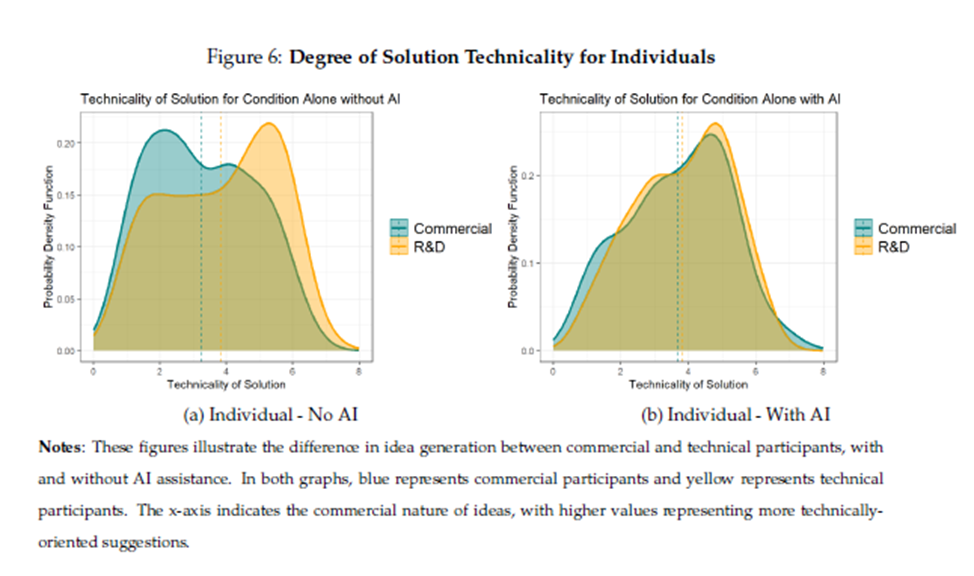
The chart above summarises the distribution of the types of solutions provided by individuals with and without AI. The image on the left shows that sales experts, when working alone, generate solutions that are very different from product experts working alone. The image on the right shows how the two profiles converge strongly regarding production when using AI.
The end of mediocrity
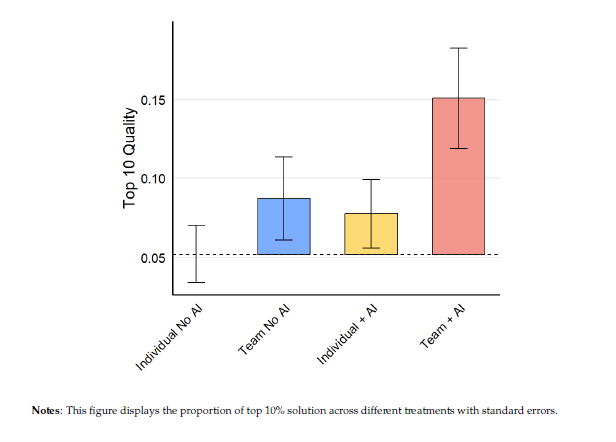
Do the researchers recommend no longer having teams work on this type of task, knowing that an individual + AI works faster, delivers higher quality and with similar expertise? When focusing on the top 10% of submissions, the value of teamwork becomes much clearer. The graph below shows that a team without AI produces almost twice the number of more high-quality ideas than individuals alone. And this difference is getting even bigger with AI.
Even more significant: the likelihood of a breakthrough impacting the entire organisation is almost three times higher in this study when teams work with AI, i.e., in mixed teams.
So that is the authors' key takeaway. Companies and organisations should not be hindered by false analogies. Those who think of AI as a tool will see the potential efficiency gains. By (adequately) positioning technology as an additional team member, other interesting opportunities arise. And this helps us think about how we will work in the future. Because things may be very different…