

Black Friday: a black day for physical shops (and search engines)?
Black Friday continues to reshape shopping behaviour. Online spending surged sharply, while physical shops showed more modest gains. Using anonymised transaction data, we examine how e-commerce, search engines and emerging AI tools influence consumer choices during the peak shopping period.

E-commerce up 70%, but LLMs still struggling to make an impact as shopping assistants
Last month, Black Friday resulted in a deluge of adverts on everyone’s screens. This phenomenon, which originated in the United States, marks the start of the Christmas shopping season. Using anonymised transaction data for digital and physical purchases, we analysed our customers’ purchasing behaviour during this period.
Mainly, but not exclusively, e-commerce
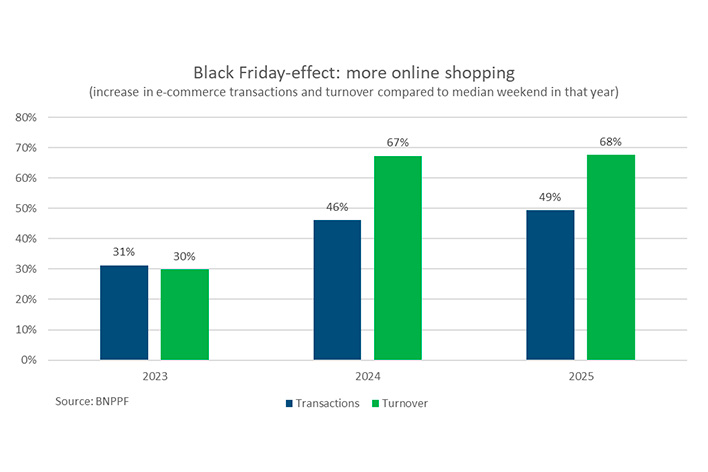
Firstly, it is worth noting that physical shops also appear to benefit. While the number of sales during the Black Friday weekend remained broadly in line with normal levels in 2023, there was an increase of almost 10% this year and last year. Total turnover also increased, rising by 14% this year, whereas it declined in 2023.
Online, however, the effect of bargain fever is much stronger. In 2023, digital turnover during the shopping weekend rose by 30%. This year, it increases by 68%. The number of transactions was also almost 50% higher.
Who advises the online shopper?
The share of e-commerce in total spending increased sharply during the Covid lockdowns. In recent years, this upward trend has continued steadily. Throughout 2025, around a quarter of spending in our dataset took place online. During the most recent Black Friday weekend, this figure rose to 33%. Online shopping therefore represents an increasingly large proportion of the budget. Influencing the behaviour of these shoppers is highly valuable, as evidenced by the hundreds of billions that marketers spend each year on digital advertising.
The end of the search engine?
Advertising on social media typically tends to be less effective than advertising on search engines. The latter benefit from the fact that users clearly signal their intent through their search query. This enables more targeted advertising to be displayed, which often results in a higher likelihood of conversion. However, AI threatens to significantly disrupt this dynamic.
Recent research shows that new users of LLMs, the technology behind the most common chatbots such as ChatGPT and Perplexity, increasingly bypass search engines. In concrete terms, their use of search engines declines by more than 20%. The result? Fewer visitors to the websites that search engines refer to*.
Chatbot shopping
But are we increasingly turning to LLMS for shopping advice?
This is a question that OpenAI CEO Sam Altman is often asked. Chatbots like his offer users unlimited tokens, either free of charge or for a monthly fee, effectively an all-you-can-eat model for a fixed price. This puts Altman and his peers at a disadvantage compared to major tech companies: while a Google search also consumes computing power, the U.S. giant can monetise every search by linking it to advertisers.
This creates a difficult balancing act for companies such as OpenAI. One might expect them to be in a strong position. Recent research indeed points to three key advantages that chatbots have when connecting purchase-minded users with the right seller:
- LLMs have more information about the context of their users, with whom they often exchange dozens or even hundreds of messages a day.
- LLMs capture more product attributes than traditional search engines, which rely more heavily on keywords.
- LLMs present purchase suggestions in the form of a conversation, making them appear both more credible and more persuasive.
The researchers demonstrate that LLMs generate more purchases than social media advertisements. However, search engines still achieve higher conversion rates (CR) and average revenue per session. Nevertheless, the study's authors do observe learning effects: the conversion disadvantage is likely to diminish further in the coming months.
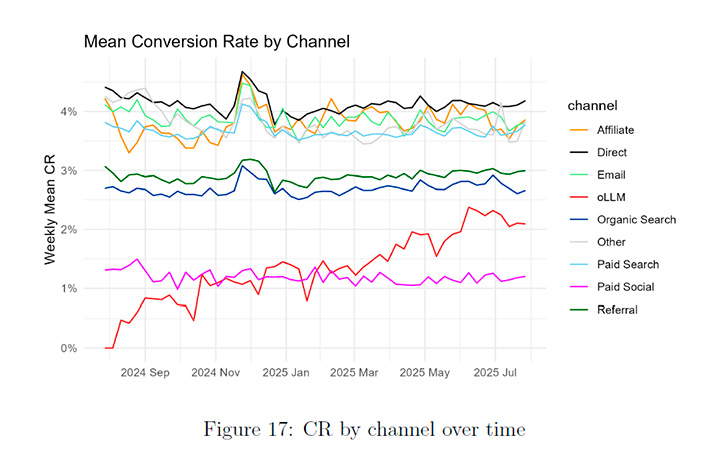
For the time being, specialised LLM developers are therefore still refraining from introducing advertising messages in their chat windows. Nevertheless, they too inevitably feel the pressure from hyperscalers with far greater financial resources breathing down their necks. Bend or break? 2026 promises to be an interesting year. But first, it is time for Christmas shopping.
* In particular, there has been a sharp decline in visits to educational websites such as Stack Overflow. Interestingly, the researchers did not observe the same effect for other community sites, such as Wikipedia and Reddit.