

Belgium’s fiscal challenge: lessons from past consolidations
Needing to cut its primary deficit by 3% of GDP within four years, Belgium faces a major fiscal challenge. Historical examples from EU and OECD countries show that expenditure-led consolidation is most effective and tends to support stronger growth afterwards. Belgium can learn from these patterns, but implementation will be difficult.

Fiscal consolidation…but how?
Countries that lower government expenditure during consolidation see on average higher growth afterwards.
The Belgian government certainly has its work cut out. Even before committing to raising military expenditure, the trajectory of public finances looked shaky at best. The primary deficit, excluding interest charges, needs to come down quickly. Reducing it to 3% of GDP over the next four years would be a good start. But how?
Looking at the neighbours
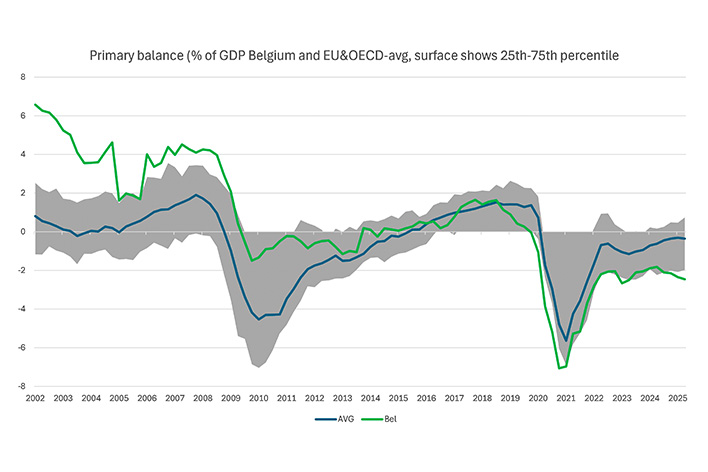
At the turn of the century, Belgium’s primary balance was healthy. In fact, it was far more positive than that of most countries currently belonging to both the EU and OECD. The graph below shows how the Great Financial Crisis, and especially the Covid pandemic, threw a spanner in the works for Belgium and many other countries.
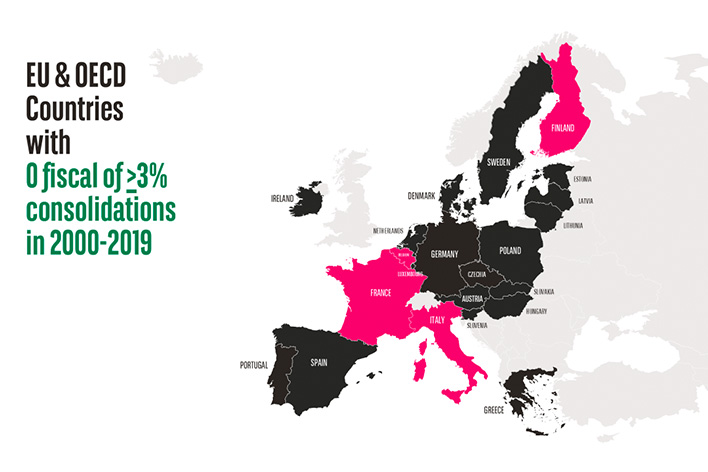
So how feasible is an improvement in the fiscal balance of 3 percentage points (or more) in four years? Looking at the 22 countries in our OECD/EU dataset, no fewer than 24 such episodes took place in the two decades before the pandemic.
Subsequent troika interventions put Greece on this list twice, as well as Germany. Portugal and the Czech Republic are the only countries to embark on three consolidation efforts. Four countries didn’t undertake any: Finland, France, Italy and … Belgium.
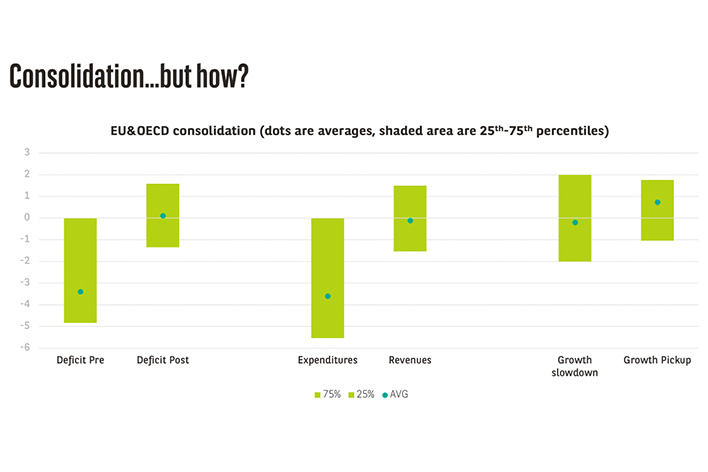
Looking back at these episodes, some interesting observations emerge. Firstly, the average episode saw the primary deficit improve by 3.6% of GDP. During the four-year period, growth averaged 0.1 percentage points lower. However, in the four years afterwards, growth accelerated by an average of 0.7 percentage points per year.
The brunt of the consolidation – in fact all of it on average – would be achieved through lower expenditure. It’s not that revenue increases played no part, but rather, on average, they didn’t contribute to improving the fiscal balance.
G for growth
Getting the balance right between lower expenditure and higher revenue is tricky. In this sample, three quarters of fiscal improvement trajectories saw a larger contribution from reduced expenditure. On average, these episodes resulted in higher growth afterwards. Conversely, revenue-dominated episodes resulted in lower growth on average.
Overall, cutting expenditure has been the dominant strategy for governments completing a primary deficit reduction programme. The Belgian government could learn from this, but the hard part surely comes next.