

AI & the labour market: why don’t you(th) get a job?
The implementation of AI could reduce the number of juniors. So where will future seniors come from?

Any sufficiently advanced technology is indistinguishable from magic.
(Arthur C. Clarke)
This is precisely the issue with contemporary chatbots. They often perform feats that hint at something resembling, or even exceeding, human intelligence. But just as often, they go off the rails. It is not always clear why or when this happens.
They may not be the most reliable assistants, but they are always available and eager to lighten your workload. Sound familiar? In fact, in yesterday’s labour market, this type of resource was known as an intern or a junior.
Where have all the juniors gone?
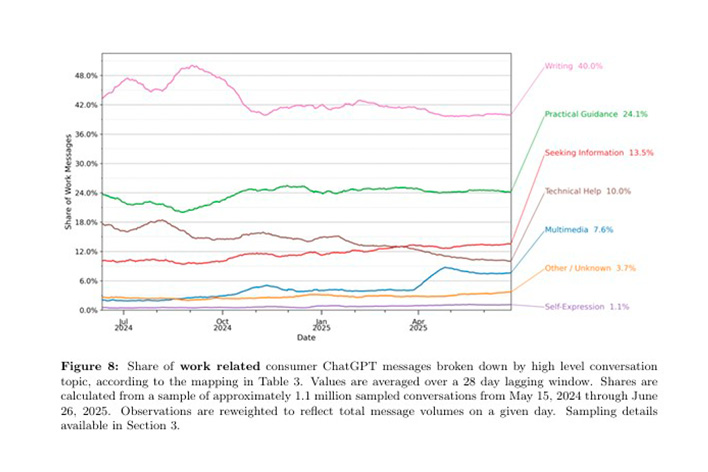
Last month’s NBER working paper, How people use ChatGPT, contains a wealth of data on one of the world’s fastest-growing consumer tech applications.
Some key takeaways: usage, as proxied by the number of prompts per day, is increasing across all groups, from early adopters to late joiners. Non-work-related usage is also gaining traction. According to the authors, work-related usage is more common among educated professionals in high-paying roles. Within that category, ‘writing’ is the primary use case. “Draft me a quick memo, junior”, has been reinvented as a chatbot prompt.
In fact, AI-generated (or more generously, ‘AI-assisted’) writing is becoming increasingly prevalent in a variety of writing domains. Corporate and government press releases, for example, as well as job advertisements all show signs of increasing ‘bot-speak’.
What do these have in common? The headline matters, the body of the text matters much less. However, readers expect a body of text, so one is required. Satisfying the constraints of an established format is grunt work. The input? It’s the kind of writing that nobody wants to do, and nobody is likely to read.
So good riddance to it. But is there hidden value in the human execution of these tasks?
Today’s juniors are tomorrow’s seniors
A large-scale investigation of U.S. job postings reveals an alarming trend that has emerged since the release of ChatGPT. Focusing on ‘AI-adopting firms’, the researchers concluded that the number of junior employees in these firms had plateaued, even though more senior workers were being hired.
The authors identified a U-shaped pattern: graduates from mid-tier institutions were most affected, while those from the top- and bottom-tier schools experienced smaller reductions. Furthermore, they found that the decline in junior hiring among GenAI adopters was not limited to the information technology sector, but was widespread.
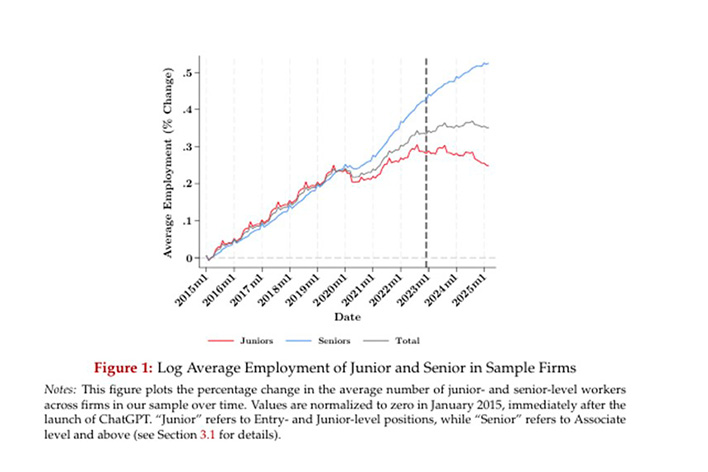
Short-term thinking might encourage some firms to cut back on junior staff, perhaps banking on their ability to hire externally for senior roles. However, this poses a significant threat to the economy as a whole in the long term. Economists refer to this as a negative externality problem. The solution – a Pigouvian tax – is well known. But don’t expect it to be implemented any time soon.