

AI and the labour market: are Belgians fearless?
Even as AI adoption accelerates and companies restructure, fear of unemployment among Belgian households is at its lowest level on record. This article explores whether this optimism is a result of government policy, confusion surrounding unemployment figures, or an underestimation of the potential impact of AI on the labour market.

The latest sentiment figures suggest a vote of confidence in the government.
An unknown fund has shaken the financial markets. Their contrarian scenario has drawn fierce criticism, yet it also sheds light on an overlooked dynamic. A rapid adoption of labour-saving technology could cause unemployment to rise. Today, fear of unemployment in our country is lower than ever before. What does that tell us?
The authors subsequently came under heavy fire.
Will AI destroy jobs?
They were particularly criticised by techno-optimists. For tech enthusiasts, tempering enthusiasm for AI is almost heretical. More mainstream commentators quickly followed suit, assessing whether the dystopian scenario could become reality. After all, a world with 10% or more unemployment within one or two years would certainly be dystopian.
For this reason alone, Citrini's work provided an interesting starting point. Over recent months, major reorganisation has increasingly been linked, explicitly or implicitly, to greater use of AI applications. Recent research also shows how companies have shifted spending from personnel costs to AI service providers.
It is therefore not in doubt that AI is changing the labour market.
Are we currently too unconcerned about a looming rise in unemployment?
Sentiment: Rosy
According to the National Bank’s consumer survey, Belgian households have become steadily more optimistic in recent months. The survey also measures fear of unemployment over the next 12 months. The chart below shows how this fear has evolved over recent months. It is measured as the share of pessimists minus the share of optimists, with a negative figure indicating lower fear of unemployment.
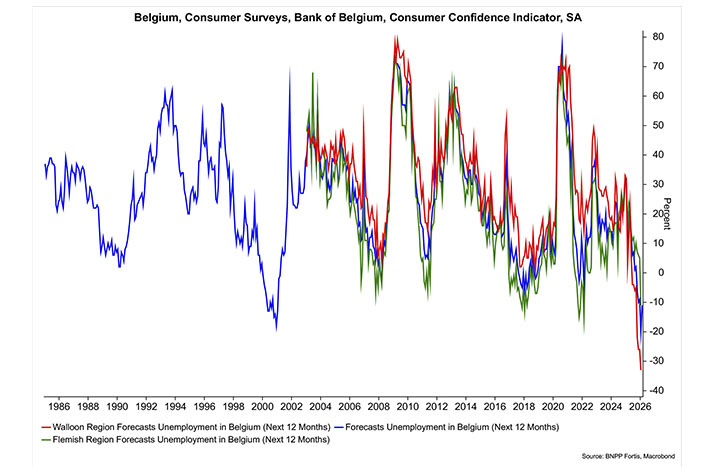
At the beginning of last year, we reported a temporary dip.
At the time, the NBB attributed this to communication by the new government. Since then, however, optimists have increasingly gained the upper hand. At the start of this year, fear of rising unemployment in our country has reached its lowest level ever. This is quite striking.
Alongside the potential disruptive impact of AI on the labour market in the coming years, Belgium also appears to be in a unique position within the EU. In neighbouring countries, where the economic cycle generally runs in parallel, unemployment sentiment has worsened in recent months. How can this be explained?
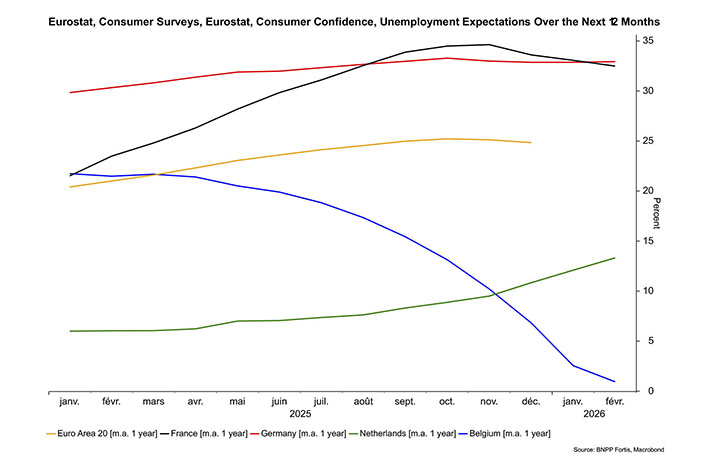
Perception versus reality
Enquiries to the National Bank reveal that several respondents told telephone interviewers that unemployment would fall as a result of government policy.
However, it seems rather unlikely that the number of unemployed people will decline today. In fact, the unemployment rate is more likely to rise than fall. This is a consequence of our current position in the economic cycle. Although we expect a soft landing, this still implies a higher unemployment rate and therefore more unemployed people.
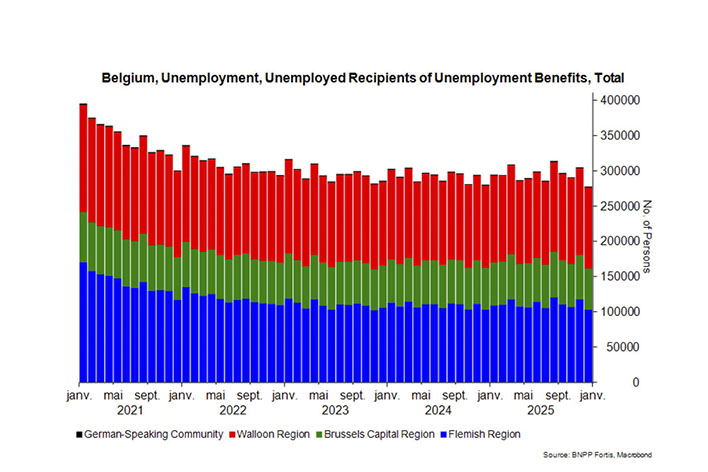
There may, however, be some confusion of terms here. In everyday language, someone is 'unemployed' when they receive benefits.
The De Wever government has made reducing unemployment benefits a key part of its policy. Here, we can already see a development that reflects the results of the sentiment survey. The number of unemployed people entitled to benefits fell at the beginning of this year. This decline is likely to continue as the announced savings measures are gradually implemented.
Lessons for the future
On the one hand, the government appears to have communicated its core ambition so effectively that measured consumer sentiment has improved. This is an impressive achievement, even though it will not directly generate economic growth.
On the other hand, the AI arms race is a genuine cause for concern regarding the transition to a difficult labour market. In this respect, the policy solution is clear. A flexible labour market with a temporary safety net helps bring such transitions to a successful conclusion.
In its recently published Article IV report, the IMF once again emphasises the importance of the proposed labour market reforms. The Fund’s economists advocate immediate investment in skills acquisition and matching workers with opportunities.
Will the government succeed in this task?
Those surveyed appear to have full confidence for the time being.