

A wind of optimism blows across Europe
In recent weeks, a wave of optimism has swept through European stock markets, even as political crises have accumulated in the United States. Spring is shaping up to be promising.

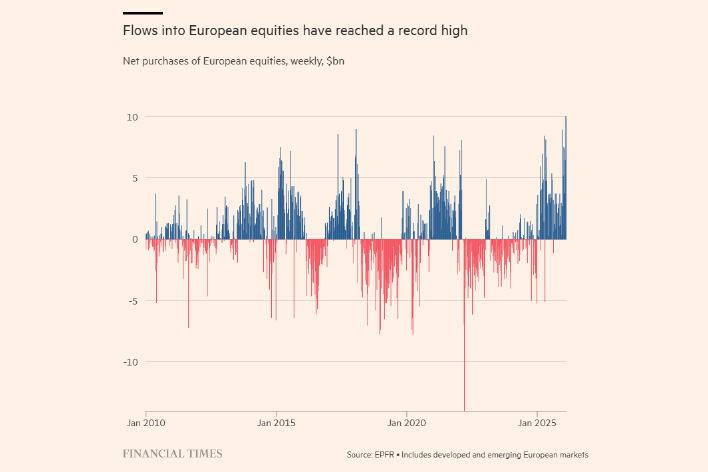
Global investors have recently invested record sums in European equities, as the desire to reduce exposure to the United States has coincided with growing optimism about the state of the European economy. According to EPFR data, which tracks ETF and mutual fund flows, European equities recorded record monthly inflows in February alone.
Europe less exposed to tech
A closer look reveals that European markets have benefited from major investors' desire to distance themselves from Wall Street and its vast technology sector. This sector has been shaken in recent weeks by concerns about a potential AI bubble. Compared to the U.S., Europe's stock market offers different exposure, with significantly fewer technology stocks and greater exposure to more traditional sectors, which appears to be attracting investors.
Although Germany continues to experience a very weak pace of growth, the country has emerged from recession for the first time since 2022. A recent increase in German factory orders has bolstered markets, and the associated rearmament spending is having a positive ripple effect across industry, restoring hope for the future. The German locomotive 2.0 may finally be gathering pace.
A new landscape in the United States
The wind has shifted once again in the United States following the U.S. Supreme Court’s decision to overturn the tariffs imposed by the President upon his return to the White House a year ago.
Wherever you look in the financial markets, there are clear signs that global investors are trying to avoid America under Donald Trump. While enthusiasm for U.S. assets has not disappeared, its nature has changed. A year ago, many believed that President Trump’s promises to deregulate the economy would boost economic growth, strengthen the dollar and make U.S. equities more appealing than those elsewhere.
Concerns about AI
Now, in the second year of Donald Trump’s presidency, the situation appears to have changed. One way to illustrate this is to examine stock market performance, particularly when comparing the United States and Europe. While the S&P 500 has remained largely unchanged since the beginning of 2026, weighed down by AI-related concerns, European and Asian markets have generally performed very well, benefiting from favourable conditions. There is now genuine optimism about Europe’s economic prospects.
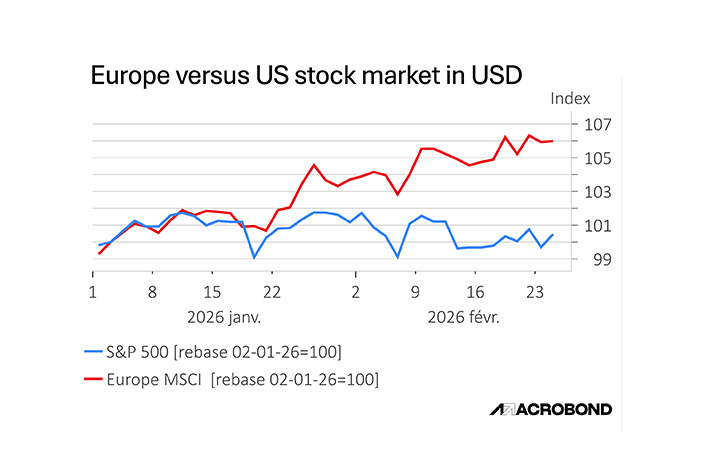
Notably, even when Trump’s tariff plans were curtailed, U.S. markets did not rebound significantly and remained relatively stable. Elsewhere, sentiment is improving, as fund inflow figures demonstrate. The world is indeed moving forward, slowly but surely, and Europe finally seems to be reaping some benefits.
Although economic surveys in the euro area are still not impressive, they are encouraging.
Europe benefits from U.S. political crises
Meanwhile, according to new data published a few days ago, the U.S. economy is growing much more slowly than previously thought, at an annual rate of 1.4%, which is similar to Europe's.
Undeniably, a heavy reliance on technological outperformance was central to the American investment miracle of the past decade. That is undeniable. However, it is faltering today, even as economic data disappoints and the country’s politics oscillate from one crisis to another. Investors are voting with their wallets, and Europe is benefiting.
Nevertheless, some investors remain sceptical about the ability of European equities to generate earnings growth comparable to that of Wall Street. Only time will tell who is right, as turbulence remains high and unpredictable.