

When demographics get in the way
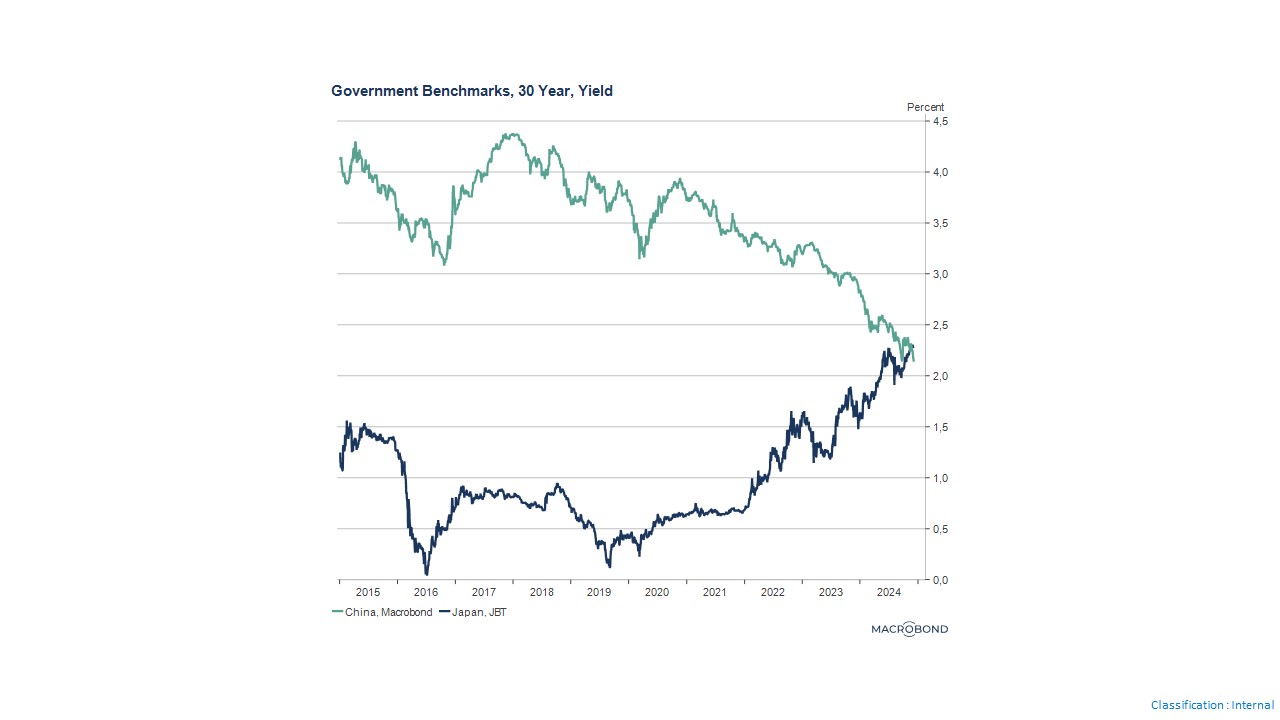
Chinese bond yields have fallen below those of Japan for the first time, with investors betting that the world's second-largest economy is becoming mired in the deflation that has long plagued its neighbour. What's happening?

China’s 30-year interest rates have fallen from 4% at the end of 2020 to 2.21% at the end of November 2024. This drop is due to Beijing cutting its benchmark interest rates to boost its slowing economy, and Chinese investors seeking safe-haven assets, which has driven down long-term interest rates even further. In contrast, Japan's bond yields, which had been below 1% for years, have now surpassed China's. This shift comes as Tokyo normalises its monetary policy after decades of deflation, while China struggles to avoid a similar economic fate, often referred to as "Japanisation".
Deflation looms
The crossover in long-term interest rates occurs as Chinese authorities exhaust all means to support economic activity, employing monetary policy, fiscal policy, and exchange rate policy. However, some investors believe that deflation has become deeply ingrained in the Chinese economy, making it resistant to resolution through fiscal and monetary policy alone. As a result, they expect yields to continue their downward trend.
When demographics get in the way
Many believe that China is on the verge of becoming a country with inevitably low interest rates, increasingly reminiscent of Japan's situation in the 1990s, when the bursting of a property bubble led to decades of stagnation. At the time, Japan was already suffering from weak domestic demand due to a lack of young people, which is also the case in China today. Underlying inflation in China, excluding energy and food, stood at an annual rate of 0.2% in October, compared to 2.3% in Japan, which reinforces the case for further rate hikes in Japan and further rate cuts in China. The promise of US President-elect Donald Trump to drastically increase tariffs on Chinese exports to the US is also seen as a threat to growth.
Insufficient stimulus measures?
China's monetary policy is likely to remain accommodative for the foreseeable future, despite temporary boosts to yields from measures aimed at stimulating the property and stock markets. The country is keen to avoid following in Japan's footsteps, which experienced a period of stagnation in the 1990s. To prevent a similar fate, China has been investing heavily in high-tech sectors, green energy, and electric vehicles to drive long-term growth. Some Chinese policymakers view low long-term interest rates as a sign of expected weakness in domestic growth and inflation, and are taking all possible measures to counter this pessimism.
Action on all fronts
It is clear that deflationary pressures have only intensified this year, leading the government to take a series of measures to restart the machine. Despite the launch of the largest monetary stimulus since the Covid-19 pandemic and a 10 trillion RMB (1.4 trillion dollar) budget plan, bond yields have continued to fall, a sign that domestic investors are seeking alternatives to China's battered stock markets. At a time when a resurgence of inflation is feared in the US, deflation is feared in China. It is likely that Chinese authorities will need to intervene further to extricate the country from this financial predicament. Notably, the central bank has been actively working to prevent the yuan from strengthening in recent weeks, by increasing its foreign exchange reserves and selling yuan to lower the exchange rate against the dollar.
The last thing the country needs is an additional obstacle that would hinder its exports (i.e. a too-strong currency). 2025 will not be easy for China either...