

Water is a critical economic investment
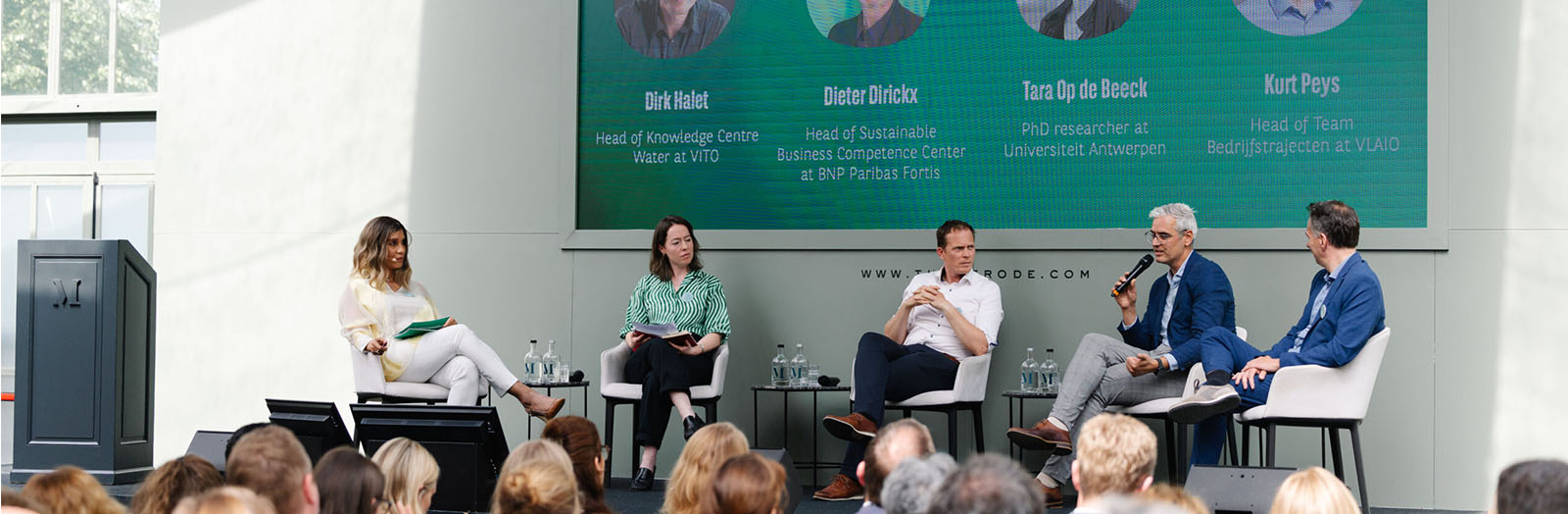
Water has undeniably become one of the key economic challenges for SMEs, cities and industry. At the Water for Growth event organised by BNP Paribas Fortis, business leaders, experts and researchers stressed that water is no longer merely a public utility – it has transformed into a strategic resource and a catalyst for sustainable economic growth. While smart water management technologies already exist, their rollout demands stronger collaboration, targeted funding and a long-term outlook.
In summary
- Water is one of today’s greatest economic challenges.
- Companies underestimating shortages risk financial exposure.
- Smart technologies exist, yet collaboration and knowledge-sharing remain insuffi-cient.
- Nature-based solutions also combat climate change while enhancing quality of life.
- BNP Paribas Fortis has funded nearly €150 million in water-related projects over 2.5 years.
A slow shift towards smart water management
Today, water is far more than just a public utility—it is a strategic resource and a driver of sustainable economic growth. Belgium ranks in the global top 20 for extreme water stress risk. Yet the transition to smart water management remains sluggish among businesses and municipalities, still hampered by gaps in collaboration, funding, and long-term planning.
“Smart water technologies already exist,” notes Dieter Dirickx, Head of Sustainable Business Competence Centre at BNP Paribas Fortis. “But to raise awareness among entrepreneurs, we must also map water’s indirect impacts.”
Dirk Halet, Strategic Coordinator at VITO Kennispunt Water, agrees: “While smart meters, membrane technologies, more efficient cooling systems, and water recovery are already in use, large-scale deployment remains limited.”
“Smart water technologies do exist. But to raise awareness among entrepreneurs, it’s crucial to also map water’s indirect impacts,”
says Dieter Dirickx, Head of the Sustainable Business Competence Center at BNP Paribas Fortis.
Costly choices
Kurt Peys, Director of Business Trajectories at VLAIO, makes the same observation: "Compa-nies often say they prefer to focus first on energy challenges, cybersecurity and AI. Water is not yet a priority for them."
He notes, however, that the situation changes rapidly when water threatens business conti-nuity. "Not investing is also a choice – and in the long run, that choice can prove extremely costly."
According to Dirk Halet, the key lies in cooperation and knowledge sharing. He cites success-ful projects in the brewing sector where companies collectively reduced water use by 10-20%. Digitalisation and data monitoring play an essential role. "When a company under-stands its water consumption, it can compare itself to others and identify areas for im-provement."
Nature as infrastructure
Alongside technological solutions, the expert debate also addressed the role of nature-based interventions. Tara Op de Beeck, a researcher at the University of Antwerp, advocates for a shift in mindset. "Nature-based solutions should be regarded as genuine infrastructure, on equal footing with roads, bridges and tunnels."
“Green roofs, infiltration zones and retention basins are solutions that not only tackle cli-mate challenges but also enhance quality of life,"
says Tara Op de Beeck, researcher at the University of Antwerp.
In her view, solutions such as green roofs, infiltration zones and rainwater retention basins address multiple challenges: water management, biodiversity, air quality and wellbeing. "These are solutions that not only tackle climate issues but also enhance quality of life."
However, these projects often face financial barriers. The benefits are widely distributed across society rather than accruing to a single stakeholder. "Everyone reaps the rewards, but no one wants to bear the full investment cost," Tara Op de Beeck summarises. New forms of public-private cooperation are therefore essential.
Financing water solutions
For BNP Paribas Fortis, water has now moved far beyond being merely a sustainability re-porting issue. Over the past two and a half years, the bank has allocated approximately €150 million in green loans to water-related projects.
“Companies often say they prefer to focus initially on energy challenges, cybersecurity and AI. Water is not yet one of their priorities,"
says Kurt Peys, Director of Business Trajectories at VLAIO.
These funds have been allocated in particular to local authorities for investments in soil de-paving and infiltration basins. "One concrete example is the city of Genk, where the project involves redeveloping, greening and depaving the city centre. It also aims to make infrastruc-ture more resilient to climate events," explains Dieter Dirickx. "This example shows how public and private actors can join forces to create positive societal impact together."
Water: a financial risk for businesses
Nevertheless, the financial risks associated with water and its management continue to grow. Companies that fail to anticipate water shortages or tightening regulations may ulti-mately face economic vulnerability.
To address these economic, ecological and social risks, VITO Kennispunt Water has devel-oped a guide to creating a "water emergency plan."
"Water shortages can lead to production losses, supply chain disruptions, quality issues, increased operational costs and reputational damage," details Dirk Halet. "At the same time, financial risks are rising due to increasing water prices, stricter discharge standards and the investments needed to boost business resilience against climate change."
"While smart meters, membrane technologies, more efficient cooling systems and water recovery are already in use today, their large-scale deployment remains limited,"
says Dirk Halet, Strategic Coordinator at VITO Kennispunt Water.
"By systematically identifying these risks and integrating them into an emergency plan, com-panies gain clearer insight into their vulnerabilities and can implement necessary measures in time to ensure business continuity. This matters not only for the companies themselves but also for finance professionals and investors, who are increasingly factoring water-related risks into their assessments," explains Dieter Dirickx.
"Our bank must indeed understand the risks a company faces. This affects its profitability and, consequently, its repayment capacity."
This is why he believes in European regulation that could accelerate visibility of water-related risks, encourage companies to act—despite the complexity of the process—and gen-erate tangible impact.
The many facets of water
According to Dieter Dirickx, many companies still have an overly uniform view of water. "We often talk about water as if it were a single entity, yet in reality, there are multiple types—drinking water, rainwater, wastewater, and so on. Each has a distinct economic and ecologi-cal value."
He therefore advocates for a radically different approach to economic activity zones: no longer treating them as isolated sites, but as circular ecosystems where each company can use water from other actors in the same area. "You need to know what your neighbour is doing. One company’s wastewater can become a resource for another."