

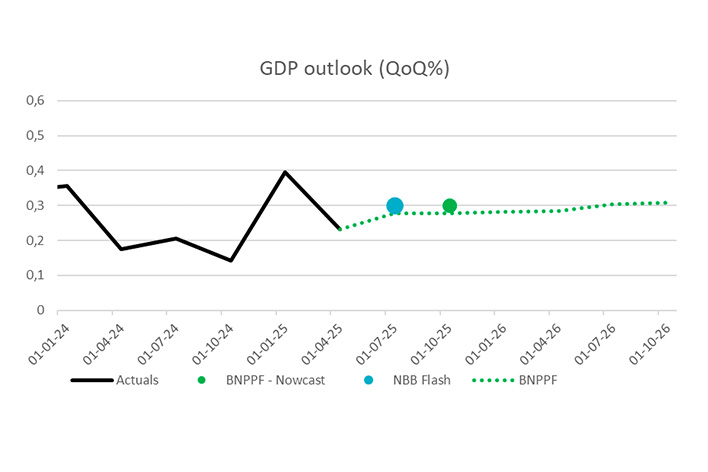
Q4 - Nowcast 1: 0.3%
Our first nowcast for the current fourth quarter confirms the stable growth seen in recent months. With one month behind us, we estimate quarterly growth at 0.3%, in collaboration with Ghent University. This is the same as the flash estimate sent out by the National Bank at the end of October for the third quarter.

This nowcast suggests that the economic engine is continuing at the same pace. We also saw this upward trend reflected in the business survey indicator. Business confidence has risen almost continuously since April, although the latest figures suggest a slight weakening. In particular, sentiment among business service providers has fallen back somewhat recently. Interestingly, manufacturers were using more of their available production capacity.
Consumer confidence is also reaching new heights. Although concerns about the economic situation in our country have increased, fears of unemployment have fallen. This decline to the lowest level in more than five years is the main driver of the overall increase in sentiment. Households surveyed also plan to save a little more.
Against this backdrop, our banking index, which measures activity levels in the economy, is also holding up well.
Revision
It is striking that the growth contributions of the largest sectors have shifted considerably in the revised figures. While the construction sector appeared to contribute little to growth in recent quarters, the revised figures show that its value added has evolved similarly to that of the economy as a whole since the beginning of 2022.
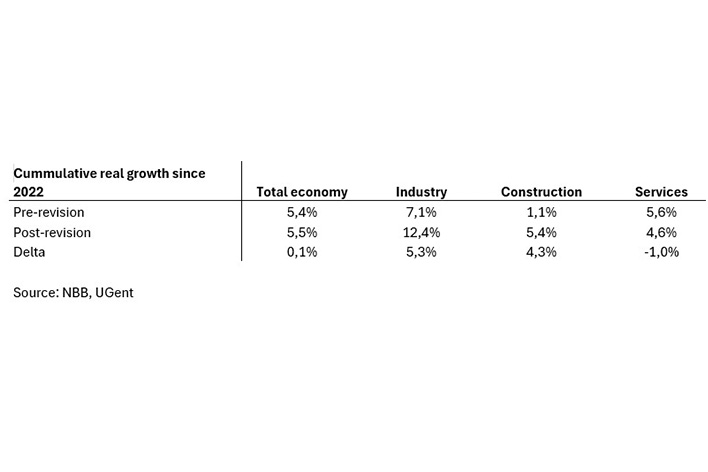 Source: NBB, Ghent University
The reverse is true in services, which account for more than half of all value added in our country. The growth in that sector is slower than previously assumed, which offsets the revised figures for both construction and industry. Overall, therefore, our economy therefore grew at roughly the same pace in real terms in the new data series as in the old one.
Nominal denominator
The GDP deflator was also revised. It turned out to be considerably higher than previously calculated. As a result, our nominal GDP increased at a faster pace than had been thought.
This is therefore a little good news for our government. The denominator used to calculate both the budget deficit and the debt ratio is increasing, causing the overall fraction to fall slightly. In other words, (in theory) a few million less will need to be found. However, it does not seem likely to become any easier.