
2026 medical entrance exam: results in Belgium
In Belgium, admission to medical studies is subject to a selection process organised at community level, in Flanders and Wallonia-Brussels. Every year, several thousand candidates register for the entrance exams organised by the country’s two communities. However, the rules differ between the north and south of the country, with different procedures and quotas. For the 2026 exams, all available places were filled on both sides of the language border.
Key figures
- In Wallonia-Brussels, 1,947 candidates were admitted, including 1,675 to medicine and 272 to dentistry.
- In Flanders, 1,881 candidates secured a place to study medicine and 280 to study dentistry.
- A total of 6,884 candidates registered for the exam in Wallonia-Brussels and 6,961 in Flanders.
- The two communities organise their exams separately, with different rules.
If you have any questions, we'll be happy to answer them!
Wallonia-Brussels: 1,675 candidates admitted to medicine
A total of 1,947 candidates were admitted: 1,675 to medical sciences and 272 to dental sciences. This was significantly more than in 2025, when 1,642 candidates secured a place.
The successful candidates included:
- 61% women and 39% men in medicine and dentistry
- 291 non-residents, representing 15% of admissions
How is the entrance exam organised in Wallonia-Brussels?
The entrance exam for medicine and dentistry is organised once a year by ARES.
- Four main subjects are assessed. The exam is divided into two parts. The first focuses on scientific subjects: chemistry, biology, physics and mathematics. The second assesses candidates’ reasoning, critical analysis and communication skills.
- 80 multiple-choice questions. The exam consists of two sets of 40 questions, one in the morning and one in the afternoon.
- Candidates are ranked. Candidates do not need to achieve a specific score to gain admission to medical studies. Instead, they are ranked according to their results. As the number of places is limited, only the highest-ranked candidates are admitted.
- The same exam for everyone. Candidates applying to study medicine and dentistry take the same entrance exam.
Flanders: 1,881 candidates admitted to medicine
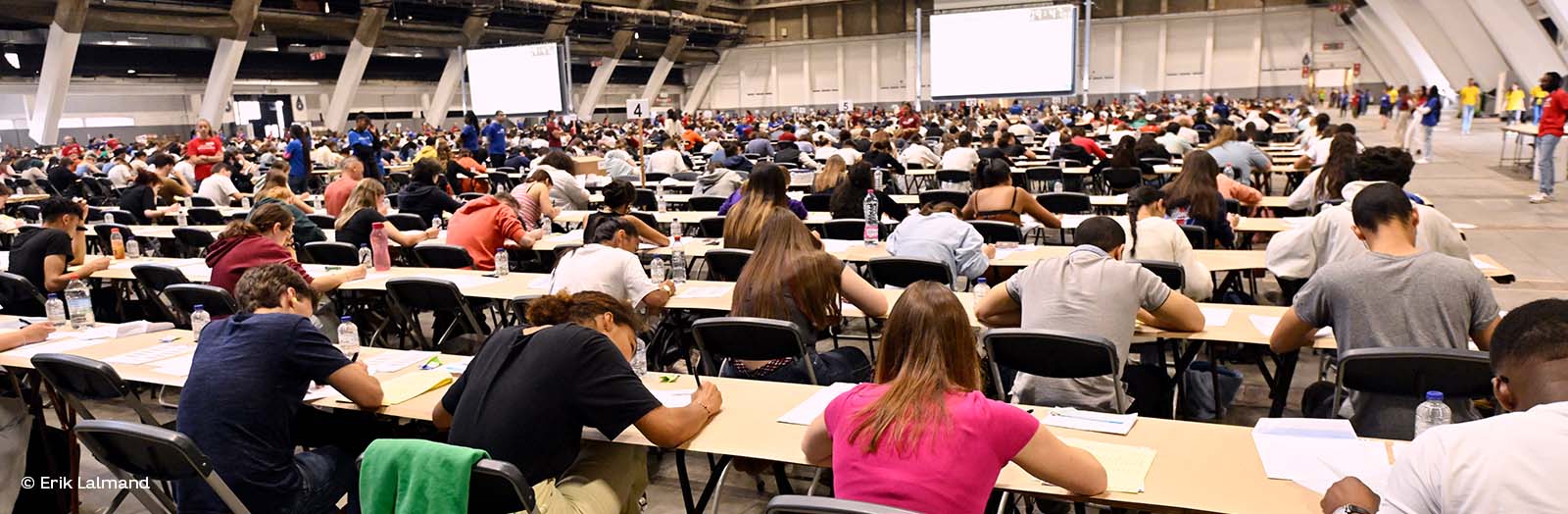
In Flanders, the entrance exams for medicine and dentistry are organised separately. The medicine exam took place on 2 July and the dentistry exam on 3 July.
A total of 6,961 candidates registered for the medicine exam, of whom 6,123 sat the exam. Of these, 1,881 candidates passed the selection process and can therefore go on to study medicine.
For dentistry, 280 candidates passed the entrance exam, out of a total of 2,116 who took it. One particular feature of the system in Flanders is that the number of successful candidates can be slightly higher than the quota. The quotas had been set at 1,878 places for medicine and 277 for dentistry. This approach avoids having to select candidates at random when they achieve the same result.
Another notable feature this year was that the exam was once again held on paper, for the first time in five years. The decision is linked to a suspicion of fraud among students. Some of them could have used artificial intelligence to get better scores during the tests.
How is the entrance exam organised in Flanders?
The entrance exams for medicine and dentistry are organised separately in Flanders.
- Four main subjects are assessed. As in Wallonia-Brussels, the exam is divided into two parts. The first includes questions on chemistry, physics, mathematics and biology. The second assesses empathy, communication and the ability to analyse scientific information.
- 80 multiple-choice questions. The exam consists of two sets of 40 questions, one in the morning and one in the afternoon.
- Candidates must achieve a minimum score and are then ranked. In Flanders, candidates must achieve at least half of the available marks in each of the two parts of the exam to be eligible. They are then ranked according to their results, with the available places going to the highest-ranked candidates.
- Separate exams. Candidates applying to study medicine and dentistry do not take the same exam. Unlike in Wallonia-Brussels, Flanders organises the two exams separately, on different dates. Candidates must register separately for each exam. They can take both, but must indicate which they prefer.
What happens next for successful candidates?
Once the results have been published, successful candidates must complete their enrolment at the university of their choice.
In both Wallonia-Brussels and Flanders, prospective medical students can view their results and a copy of their exam online. Successful candidates can download their admission certificate, which they need to complete their enrolment at their chosen university.
If you have any questions, we'll be happy to answer them!