

AI First companies: more engineers, fewer managers
The colossal valuations of artificial intelligence companies, or those linked to AI, are fuelling high hopes. This technology has the potential to significantly accelerate economic growth. Various real-world experiments show that employees are far more productive when using tools based on Large Language Models (LLMs). At the same time, companies are also becoming more productive – and not just because employees work faster with a chatbot at their fingertips.

AI increasingly integrated into products
Researchers Hyunjin Kim and Rembrand Koning point out that AI is increasingly embedded directly in products, so that tasks previously performed in-house by humans are now performed directly via software. Productive capacity is therefore shifting from the organisation to the product.
Drawing on data from Y Combinator and PitchBook, Kim and Koning compare AI native start-ups (those that integrate AI into their processes) with comparable companies that do not use AI. They cross-referenced this data with information on team size, role distribution, seniority and organisational hierarchy. The authors thus examine not only whether companies that use AI perform differently, but above all whether they are organised differently. Their key distinction is between AI as an internal tool for employees and AI as a key component of what companies sell.
Conclusive results
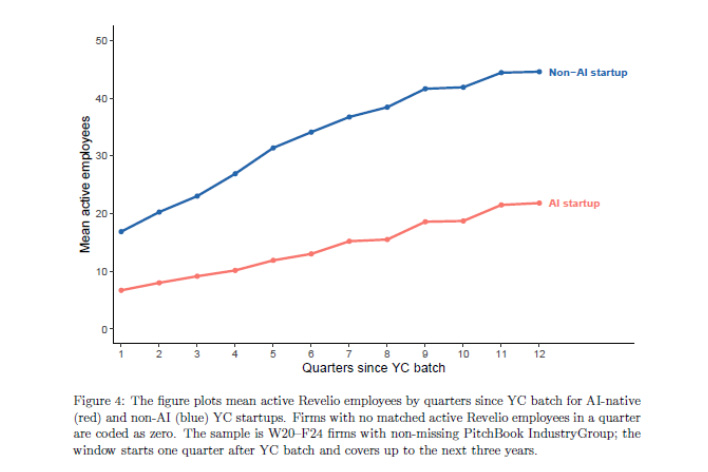
AI native teams are smaller on average throughout the development phase (as shown in the graph below). They are also more technical, with a higher proportion of engineers and fewer commercial, operational, financial or administrative staff. This confirms the idea that some tasks are shifting from human execution to product development and maintenance.
This is all the more interesting as experience often shows that one of the main effects of AI is to boost the productivity of less experienced employees. You might therefore expect AI native companies to rely more heavily on junior staff. Yet, the study shows the opposite trend: these companies actually have a proportionally lower number of junior positions and a higher proportion of senior profiles. When it comes to tasks, AI therefore often seems to be either replacing junior staff or providing them with additional support. But when you look at the organisational impact, AI mainly benefits technical and experienced staff.
Smaller, more experienced and technically skilled teams also require different ways of working together. The authors observe less vertical hierarchical structures: the median AI native company has 3 hierarchical levels, one less than the reference group. The proportion of managers is also lower. This indicates flatter organisations, with less need to coordinate large numbers of employees.
Are companies that adopt AI more productive?
The authors remain cautious, but the evidence seems to confirm this trend. AI native start-ups achieve comparable valuations with fewer staff, which results in higher value created per worker and therefore better capital efficiency.
The key lies in how AI is integrated into the product. It automates tasks once done by humans, amplifies the impact of experts, or provides an infrastructure on which others can build their projects. This is the study’s key finding: more AI in the product often means less human labour, both within the start-up and for customers.
Does AI create fewer jobs?
The authors avoid the trap of a simplistic conclusion that AI automatically destroys jobs. As AI also lowers the barriers to starting a business, its adoption could, on the contrary, encourage the launch of new start-ups. The study is, however, more categorical on the role of managers: this role is evolving, shifting from the development of internal capabilities to the intelligent integration of external capabilities that rely on AI.